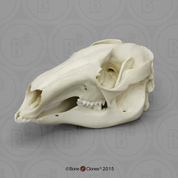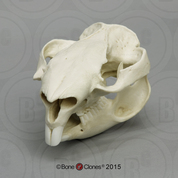


| Miscellaneous Mammals - We have a selection of unusual and distinctive mammal skulls, teeth, antlers, including a Warthog with stunning tusks (available separately), Tasmanian Devil, Tasmanian Wolf, Wolverine, Giant Anteater, Giant Armadillo and Chinese Water Deer (with fangs). Bone Clones also produces teeth from Elk, Munjac and an Asian and African Elephant. Additionally, we produce a rack of Moose Antlers (painted), a Doe Deer skull and more. |
Catalog # | Product Name | Description |
|---|---|---|
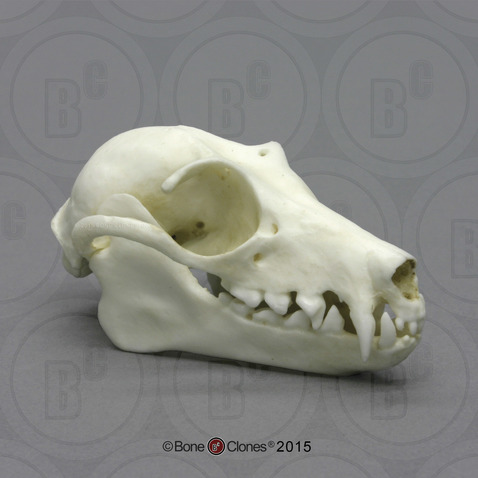
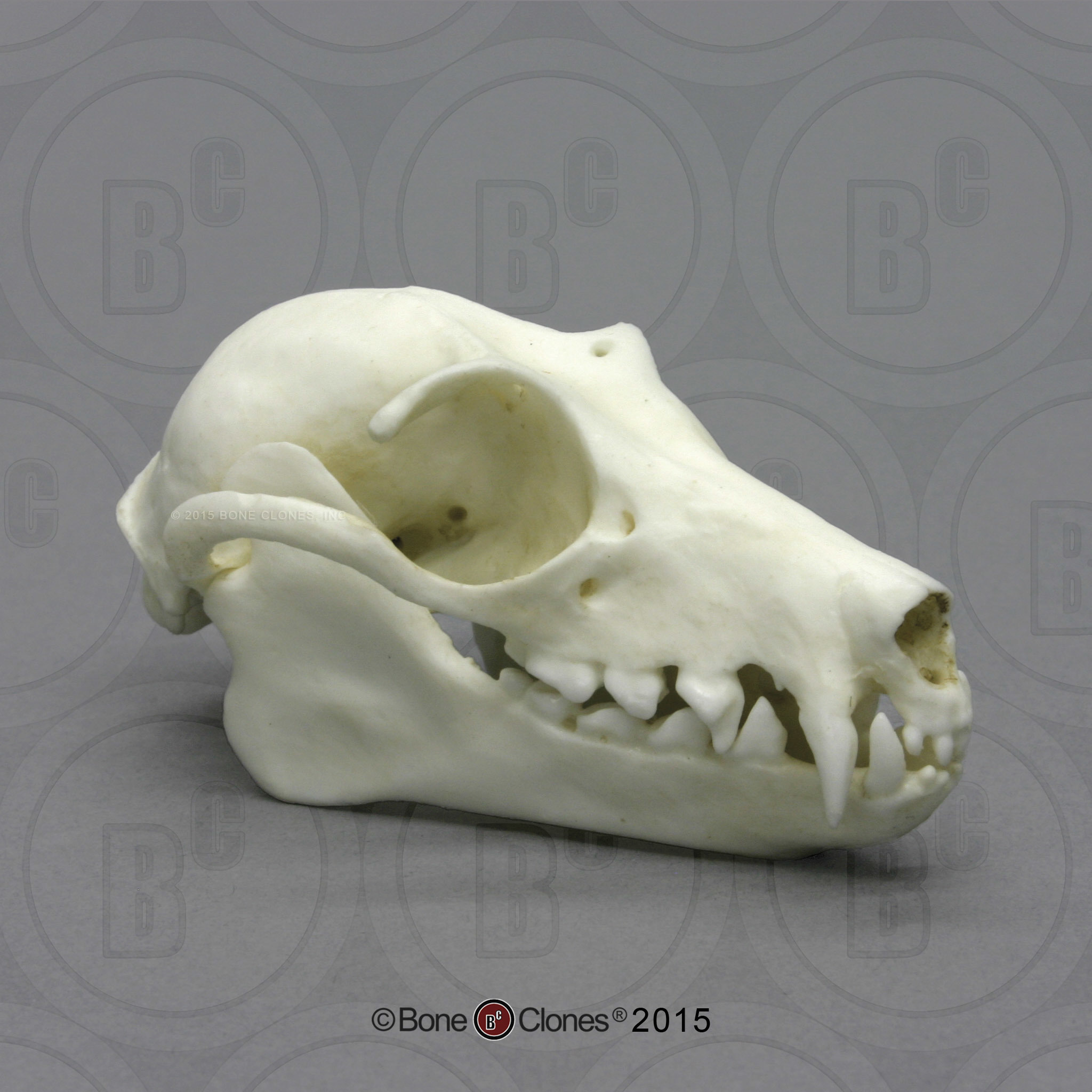
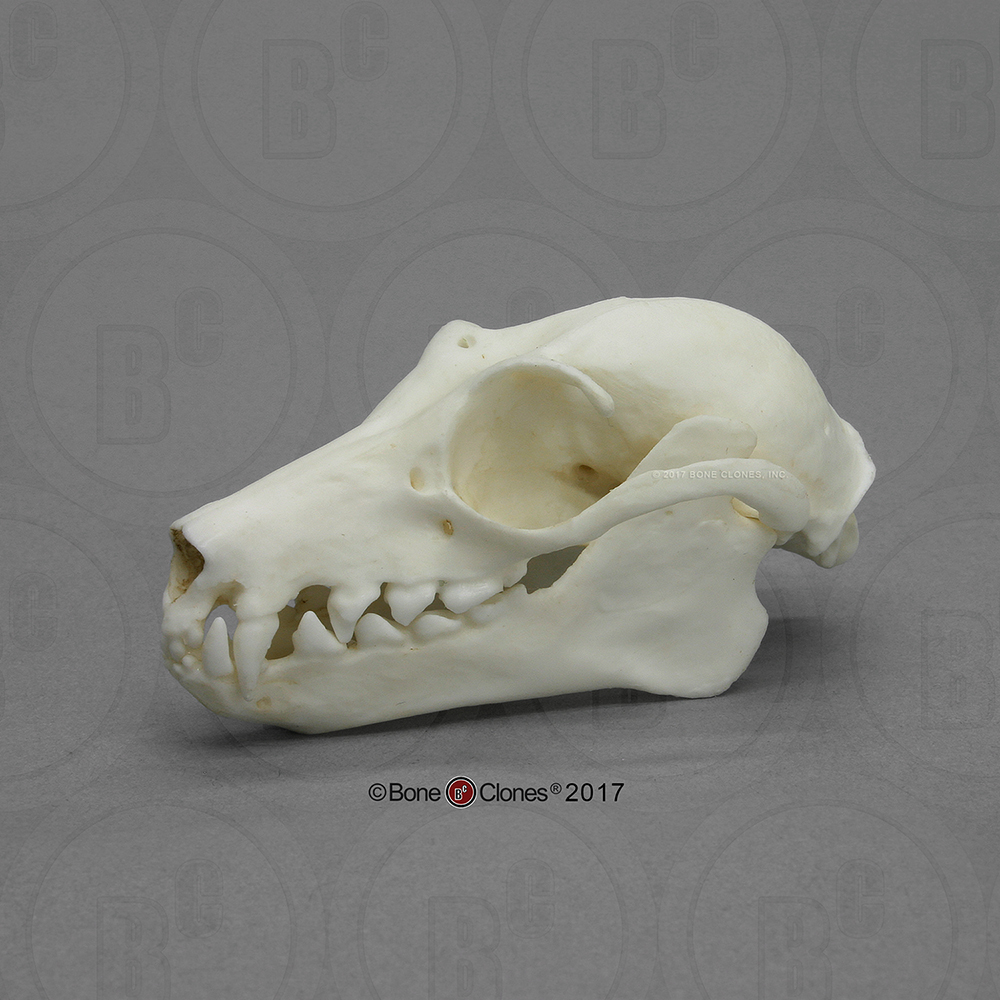
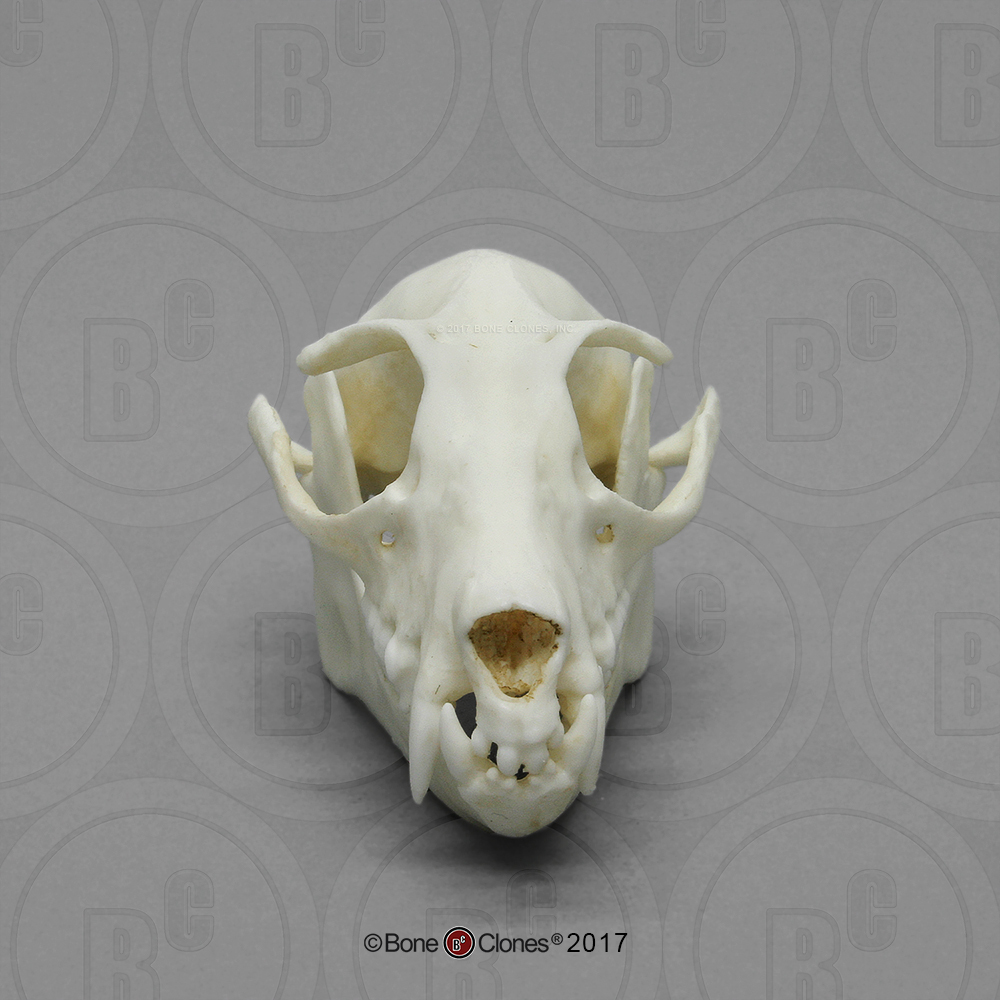
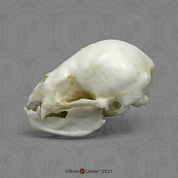
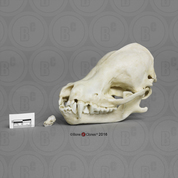
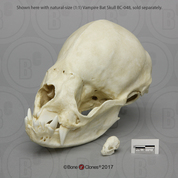
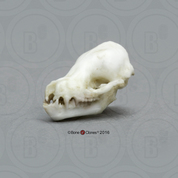
BC-007 | Fruit Bat Skull | Pteropus poliocephalus is also known as an Old World Fruit Bat (or the Grey-Headed Flying Fox). It is found along the Australian coast. Bats are the only mammals to have evolved true flight. There are over 154 species of Old World fruit bats existing worldwide... |
BC-011 | Giant Anteater Skull | The Giant Anteater, found in Central and South America, has a very distinctive appearance, high-lighted by its curved, tubular snout. It reaches lengths of more than 7 feet and weights beyond 80 pounds... |
![]() BC-012 | Tasmanian Wolf Skull | The Thylacine is also known as the Tasmanian Tiger (due to its striped fur) or the Tasmanian Wolf although it is, in fact, a marsupial... |
![]() BC-013 | Tasmanian Devil Skull | The Tasmanian Devil is the largest extant marsupial carnivore. It is a hunter/scavenger with a short, compact body and a large, powerful head. It is said to rival the spotted hyena, pound for pound, in jaw strength... |
![]() BC-025 | Giant Panda Skull | Giant Pandas with their distinctive black and white coloration are favorites the world over. They are cousins to bears with their lineages splitting off millions of years ago. The most specialized herbivore of all carnivores, their diet consists of 99 percent bamboo... |
BC-032 | Hyena Skull | Hyena Skull, Unusual among mammals, the female Spotted Hyena is significantly larger than the male and more aggressive... |
BC-041 | Warthog skull | This amazing Warthog skull holds the world record for the largest warthog tusks. Its beautifully curved upper tusks are over 20 inches long, giving its skull an almost sculptural appearance. |
![]() BC-071A | Giant Fossil Beaver Skull Antique Finish | Belonging to the Pleistocene era, Rancholabrean epoch, the Giant Beaver became extinct about 10,000 years ago... |
![]() BC-071T | Giant Fossil Beaver Skull Tarpit Finish | Belonging to the Pleistocene era, Rancholabrean epoch, the Giant Beaver became extinct about 10,000 years ago... |
BC-089 | Giant Armadillo skull | The Giant armadillo is classified in the order Xenarthra, which means "strange joint," an apt description of their unusual cervical vertebrae. Xenarthra is a diverse mammalian group that originated in South America and includes the extinct giant armored gylpodont and the ground sloth... |
BC-090 | Wolverine skull | Related to ferrets and weasels, Wolverines are the second largest living member of the family Mustelidae... |
BC-091 | Chinese Water Deer skull | Originally from China and Korea, Chinese Deer have been introduced and are now wild in England and France. They are relatively small in size and lack antlers. The most startling feature, especially in the males, is the extraordinarily large canine teeth... |
BC-100 | White-tailed Deer Doe Skull | White-tailed deer inhabit tropical and temperate deciduous forests ranging from Canada through much of South America. They are the most common ungulate in North America and the number one large game animal for hunters... |
BC-100E | Economy White-tailed Deer Doe Skull | White-tailed Deer Doe Skull, economy version of our BC-100 deer skull... |
![]() BC-125 | Horse skull | The large and slender horse skull has long, broad, tapering nasals. At the front of the mouth are large incisors, designed for cropping grass... |
BC-164 | Muntjac Skull | Also called the Barking Deer, the Muntjac barks when predators are near. They are relatively common in their home range of China and Taiwan with over 600,000 individuals... |
BC-214 | Giant Fossil Armadillo Skull | Giant fossil armadillo From the late Pliocene, early Pleistocene era (early Irvingtonian), circa 1.8 MYA. Found in a land site, 2 of the teeth were found in the Aucilla river, Florida. Lower jaw not found but may be available at a future date... |
BC-223 | Giant Fossil Hyena Skull | From China, found in a location fairly common for large fossil cats, this particular specimen was discovered in the Gansu province, Guanghe Formation, China and was dated at around 4.5 to 5 MYA... |
BC-251 | Babirusa Skull | A member of the pig family, the Babirusa is found in the rainforests on some of the Indonesian islands. Its most striking feature is its two sets of tusks... |
![]() BC-283 | Fairy Armadillo Skull | The Pink Fairy Armadillo lives in the dry grasslands and sandy plains of Central Argentina. The smallest of the armadillos, it may reach lengths, including its tail, of 6 inches... |
BC-288 | Common Armadillo Skull | The Common Armadillo (Nine-banded) is found in North, Central and South America. Apparently taking advantage of roads and bridges, its range has gradually expanded further to the north and east of the United States... |
BC-308 | Aardvark Skull | Aardvarks are found in sub-Saharan Africa in areas of grassy plains, savanna, bushland and woodland. This nocturnal mammal has a stout body with a long head and snout that brings to mind the head of the anteater (they are not closely related)... |
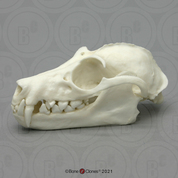
BC-312 | Greater Flying Fox Skull | The common name for Pteropus vampyrus is the Flying Fox, which alludes to the color of this bat's coat and its fox-like face. It is the largest of the fruit bats with a wingspan of five feet... |
![]() BC-313 | Bison antiquus Skull | The skull of this specimen is considered to be one of the finest and largest found to date. With a horn spread of 31 inches, associated skeletal elements also available... |
KO-286-SET | Babirusa Tusks | Available separately, our set of 4 tusks from our Babirusa Skull. Expertly painted to simulate the real tusks... |
KO-031 | Walrus Tusks (pair) | A pair of tusks from our partial Walrus skull, BC-108. Both Male and Female Walrus canines develop into great tusks, which are used primarily to signify social status... |
KO-031S | Walrus Tusk (single) | Walrus Tusk (single) KO-031S. One of the pair shown here. ... |
KO-032 | Walrus Tusk (giant) | This Giant Tusk measures 34 inches. Note that this tusk is not associated with our Walrus Skull and is not part of the pair... |
KO-045 | African Elephant Tooth | This impressive molar from the largest land mammal alive clearly shows the large grinding surface area used to break down the Elephant's herbaceous and woody foods... |
KO-100-CANIDS | Set of 4 Canid Claws in Riker Box | This set of four claws includes Bone Clones replicas of Wolf, Fox, Raccoon and Coyote. Perfect for comparative study and displayed in a glass fronted Riker Box... |
KO-100-SET-31 | Set of 31 Claws in Riker Box | A beautiful set of 31 Bone Clones replica claws and talons, and a savings when purchased as a set. Perfect for comparative studies and display... |
KO-118 | Bison Antiquus Right Tibia | This right distal tibia displays two deep V-section chopmarks, suggesting blows from a heavy object. It has been suggested that this bison was butchered by humans... |
KO-119 | Bison Antiquus Right Metatarsal | Right Metatarsal found associated with other skeletal elements during excavation of the Ayer Pond, Orcas Island Pleistocene site... |
KO-158 | Mastodon Molar | Fossils of Mastodons (including entire skeletons) have been found in many areas of North America, where they existed until about 10,000 years ago... |
![]() KO-197 | Woolly Mammoth Molar | Mastodons and Mammoths belong to the order Proboscidea, which also includes the African and Indian Elephants... |
![]() KO-198 | Columbian Mammoth Molar | The Mammoth's teeth had long ridges, suitable for grinding grass. As is the case with all Proboscideans, a worn down set of teeth would be replaced by another, for a total of six sets during their lifetime... |
![]() KO-199 | Mastodon Molar | The Mastodon's teeth have cone-shaped cusps and were built for chewing leaves and twigs. The Mastodon was shorter than the Mammoth and had much straighter tusks... |
KO-224-4 | Warthog Tusks (set of 4) | The beautifully curved upper tusks are over 20 inches long. The Warthog's sharp lower canines are continually honed by contact with the upper canines... |
![]() KO-313 | Asian Elephant Tooth | Asian Elephants belong to the family Proboscidea (descriptive of their unique trunks), and are more closely related to the now-extinct Mammoth than the Indian Elephant. Elephant teeth are the largest teeth of any living animal... |
KO-501 | Mastodon Vertebra | Mammut americanum, the Mastodon, became extinct about 10,000 years ago. The individual from which this vertebra (T3) came died approximately 12,450 years ago... |
SC-125 | Articulated Horse Skeleton | This male specimen was a large retired police horse. Horses have played an important role in human culture since their domestication... |
SC-125-67-AS | Horse Front Leg with Scapula, Articulated SC-125-67-AS | We include the scapula, humerus, forearm, cannon bone and foot. The foot consists of the long pastern bone or first phalanx, the short pastern bone or second phalanx and the coffin bone or third phalanx. The coffin bone is enclosed by the hoof... |
SC-125-67-DS | Horse Front Leg with Scapula, Disarticulated SC-125-67-DS | We include the scapula, humerus, forearm, cannon bone and foot. The foot consists of the long pastern bone or first phalanx, the short pastern bone or second phalanx and the coffin bone or third phalanx. The coffin bone is enclosed by the hoof... |
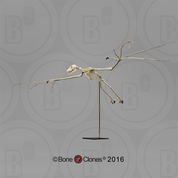
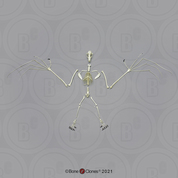
SC-312-A | Greater Flying Fox Skeleton Articulated | Found in Southeast Asia, Pteropus vampyrus is the largest of the fruit bats, with a wingspan of five feet. Its common name (Flying Fox) comes from its fox-like face and the color of its coat... |
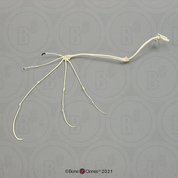
SC-312-D | Greater Flying Fox Skeleton Disarticulated | The Disarticulated Greater Flying Fox Skeleton is not fully disarticulated. The following sections have been assembled: ribcage, tarsals and metatarsals, pelvis and lumbar vertebrae, cervical vertebrae, carpals and metacarpals... |
![]() SC-125-FOOT | Horse Foot, Flexible | The horse's foot is from our Horse Skeleton SC-125-A. The foot consists of the long pastern bone (or first phalanx), the short pastern bone (or second phalanx) and the coffin bone (or third phalanx)... |
SC-125-HY | Horse Hyoid | The hyoid apparatus consists of the stylohyoid bones (these are the long pair), which connect to the skull's styloid processes, the thyrohyoid bones (these are the shorter pair), which connect to the larynx... |
![]() SC-125-D | Disarticulated Horse Skeleton | This individual was a large, retired male police horse. Domestic horses vary extensively in size and coloration, with over 180 extant breeds, including miniature horses, ponies, hot bloods... |
If you would like to receive updates about Bone Clones® events, new products and special sales, enter your email address in the box below, and click on GO.
|