

 Catalog # | Product Name | Description |
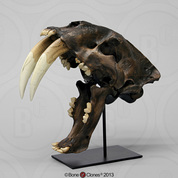
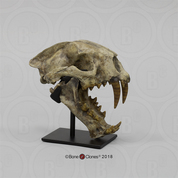
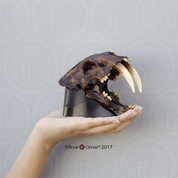
 BC-018A | Sabertooth Cat Smilodon californicus Skull Replica Antique Finish | One of the finest specimens from the Los Angeles County Museum of Natural History. Great care was taken when we cast this piece to preserve every detail and nuance of the original specimen... |
 BC-018T | Sabertooth Cat Smilodon californicus Skull Replica Tarpit Finish | One of the finest specimens from the Los Angeles County Museum of Natural History. Great care was taken when we cast this piece to preserve every detail and nuance of the original specimen... |
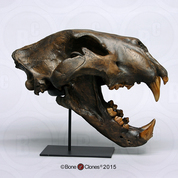
 BC-019A | American Lion Skull Antique Finish | Felis atrox was the largest lion to have ever existed, this individual weighing an estimated 900 pounds. Found only in the western hemisphere, this 14,000 y.o. specimen came from the La Brea tar pits... |
 BC-019T | American Lion Skull Tarpit Finish | Felis atrox was the largest lion to have ever existed, this individual weighing an estimated 900 pounds. Found only in the western hemisphere, this 14,000 y.o. specimen came from the La Brea tar pits... |
 BC-020A | Dire Wolf Skull Antique Finish | Same skull as our BC-020T, but with a lighter Antique Finish... |
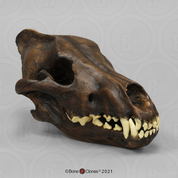
 BC-020T | Dire Wolf Skull Tarpit Finish | Thriving during the Pleistocene, the Dire Wolf is not a direct ancestor of any of today's known species of canine. They co-existed in North America with Grey Wolves for about 100,000 years. Dire Wolves had short, thick legs, a larger, broader skull... |
 BC-030 | Dinictis Skull | Dinictis lived on the plains of North America 35-40 m.y.a. Ancestors to modern cats, this ancient skull is reminiscent of today's clouded leopard skull... |
 BC-040 | Thoosuchus Skull | Thoosuchus were semi-aquatic batrachomorphs that lived worldwide over 200 million years ago. Similar in appearance to salamanders, thoosuchus are the most likely ancestors of the modern day tail-less amphibians we call frogs... |
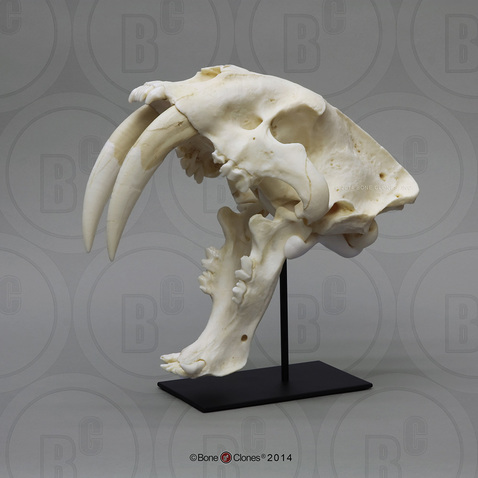
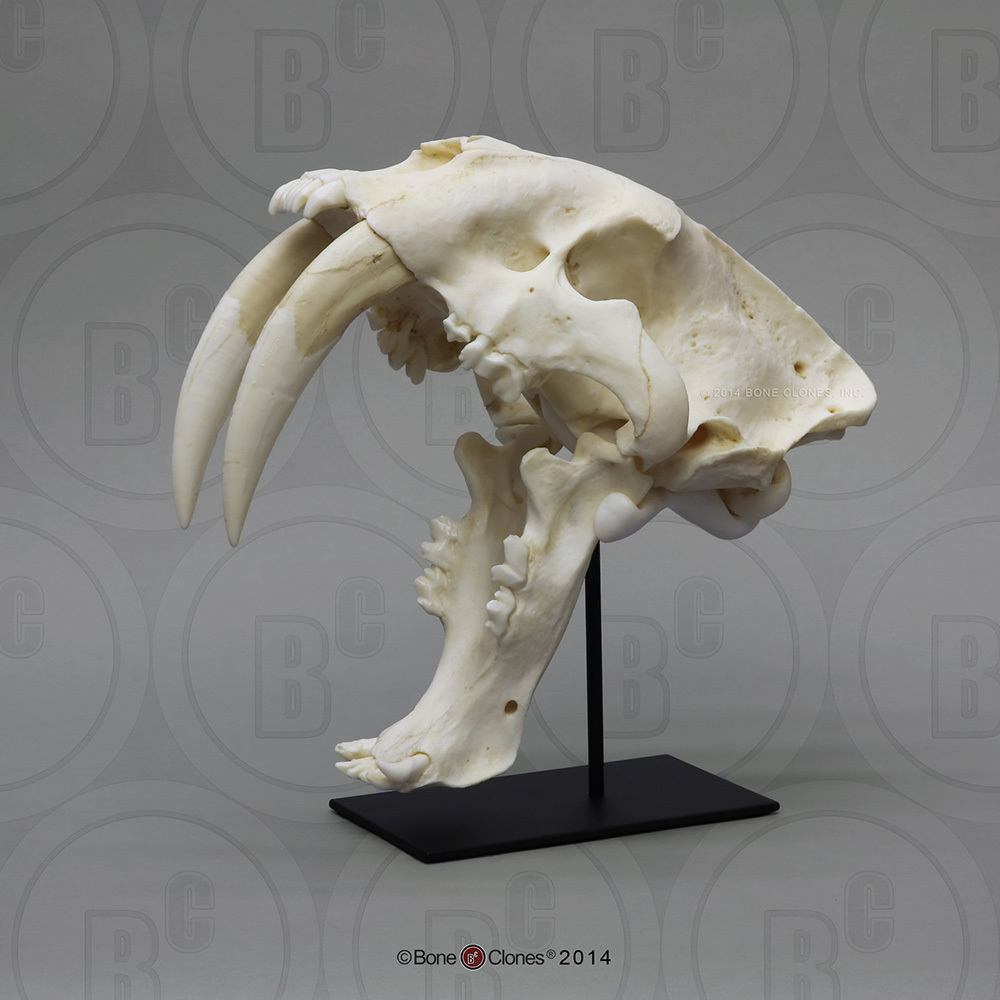
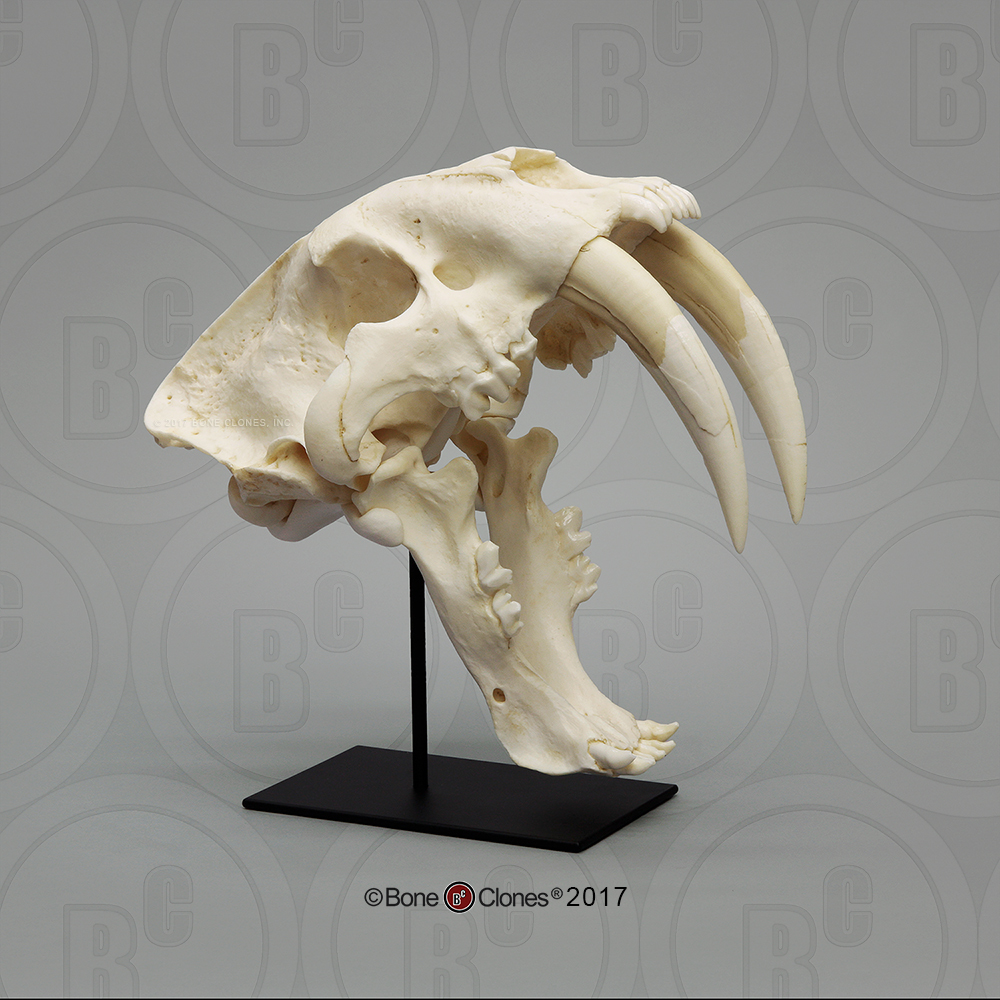
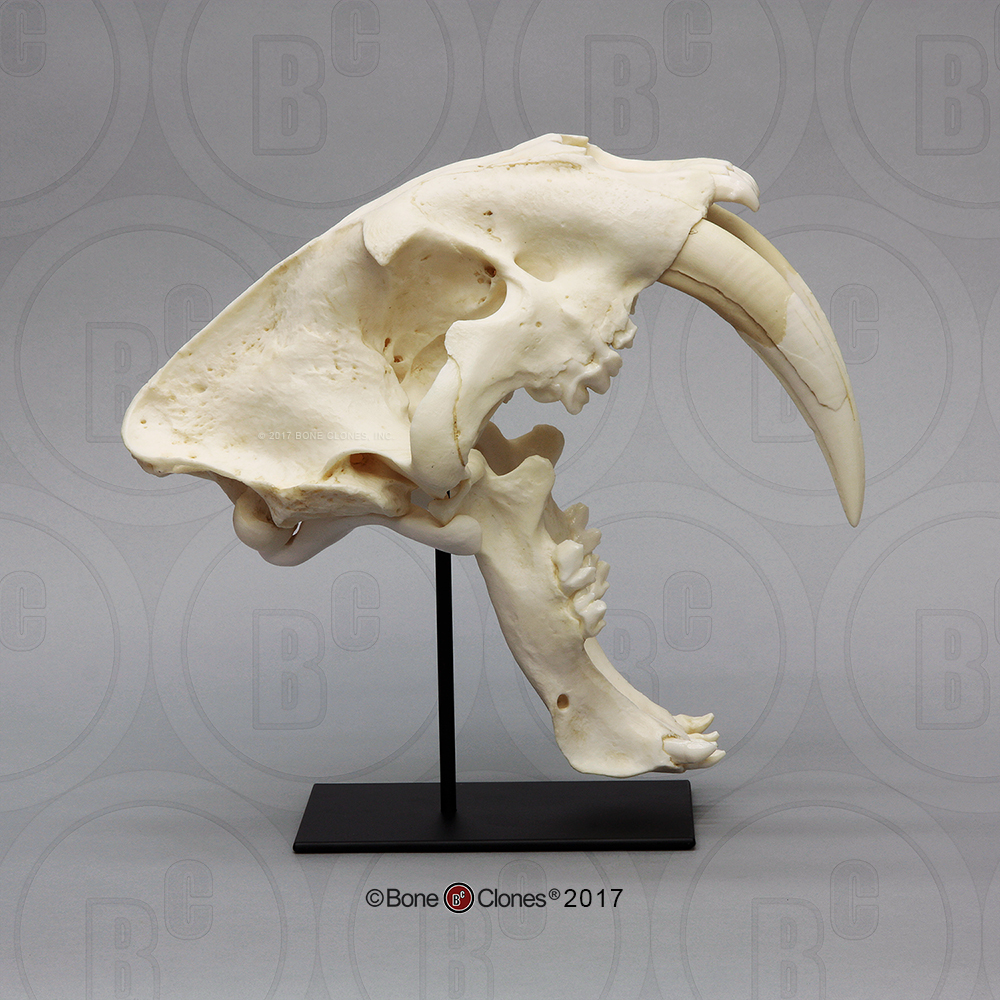
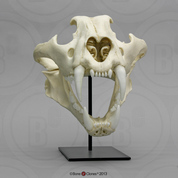
 BC-067T | Deluxe Sabertooth Cat Skull Tarpit Finish | Delux Smilodon Skull Tarpit Finish. Found in the 1930's across the street from the La Brea Tar Pits. The site was immediately clo ... |
 BC-067A | Deluxe Smilodon Skull Antique Finish | Our large deluxe Sabertooth Cat is now also available in antique finish... |
 BC-071A | Giant Fossil Beaver Skull Antique Finish | Belonging to the Pleistocene era, Rancholabrean epoch, the Giant Beaver became extinct about 10,000 years ago... |
 BC-071T | Giant Fossil Beaver Skull Tarpit Finish | Belonging to the Pleistocene era, Rancholabrean epoch, the Giant Beaver became extinct about 10,000 years ago... |
 BC-093 | Homo sapiens Cro-Magnon skull | 10,000-30,000 YA. This Cro-Magnon Skull was discovered in 1998 in the Rhine River deposits in Southwest Germany near Mainz (the jaw was also found in this region)... |
 BC-093-C | Homo sapiens Cro-Magnon skull and Jaw | 10,000-30,000 YA. This Cro-Magnon Skull was discovered in 1998 in the Rhine River deposits in Southwest Germany near Mainz (the jaw was also found in this region)... |
 BC-102 | Machairodus giganteus Skull | Machairodus giganteus. Age: Late Miocene, China. This cat lived approximately 4.5 to 5 million years ago and was about the size of a lion, but with a longer muzzle and narrower skull. Machairodus is an excellent example of a saber-toothed cat... |
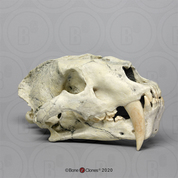
 BC-103 | Smilodon populator Skull | Smilodon populator lived in the eastern part of South America. The three species recognized in the Smilodon genus became extinct only about 10,000 years ago... |
 BC-104 | Cave Lion Skull | Cave Lion Skull BC-104 The Cave Lion became extinct approximately 15,000 years ago. These large, conical-toothed cats of the North American Ice Age ... |
 BC-106 | Megantereon nihowanensis Skull | Megantereon cultridens (nihowanensis). Late Miocene to earliest Pleistocene. ( 6 - .9 mya) China. The genus Megantereon has a very long history in the fossil record... |
 BC-113 | Xenosmilus hodsonae Skull | Xenosmilus hodsonae Skull BC-113 Xenosmilus hodsonae Occurence: Pleistocene (Irvingtonian) (1.7-1 MYBP), Florida... |
 BC-114 | Short-Faced Bear Skull | Bear, Short-Faced, skull BC-114. Arctodus simus (Cope-1897), which is more closely related to the Andean Bears, Tremarctos than to Ursus, have been ... |
 BC-117 | Juvenile Machairodus giganteus Skull | Juvenile Machairodus giganteus Skull BC-117 . Age: Late Miocene, China. Living approximately 4.5 to 5 million years ago and about th ... |
 BC-130 | Gavialosuchus Skull | Discovered in 1990 in a phosphate mine in Polk County, Florida, this Gavialosuchus skull is considered the largest, most complete specimen ever found... |
 BC-132 | Cave Bear Skull | The Cave Bear lived in Europe from about 300,000 to 15,000 BC. It became extinct at about the time Cro-Magnon appeared. This particular skull is among the largest and most complete ever found... |
 BC-156 | Sarcosuchus imperator Supercroc Skull | Sarcosuchus imperator (flesh eating crocodile), nicknamed Supercroc, lived during the Cretaceous period (65 - 144 MYA). With an estimated body length of 40 feet, and a skull over 5 1/2 feet long, Supercroc is one of the largest crocodiles that ever walked the Earth... |
 BC-159 | Wooley Mammoth Skull | The Mammoth lived in North American for the last 2 million years and became extinct about 10,000 years ago.The twisted tusks identify this species. Our specimen was a juvenile... |
 BC-159-S | Wooley Mammoth Tusk Single | From our Mammoth Skull BC-159. The single Tusk is 7 1/2 feet long.... |
 BC-159-P | Wooley Mammoth Tusks Pair | From our Mammoth Skull BC-159. The pair of Tusks are 7 1/2 feet long.... |
 BC-160 | Mosasaur Platecarpus planifrons Skull | Platecarpus planifrons, a medium-sized mosasaur that lived approximately 86 MYA during the late Cretaceous Period. One of only a few known, this specimen is the best in existence. Complete with pterygoid teeth... |
 BC-160-N | Mosasaur, Platecarpus Skull and Neck | Platecarpus planifrons, a medium-sized mosasaur that lived approximately 86 MYA during the late Cretaceous Period. One of only a few known, this specimen is the best in existence. Complete with pterygoid teeth... |
 BC-214 | Giant Fossil Armadillo Skull | Giant fossil armadillo From the late Pliocene, early Pleistocene era (early Irvingtonian), circa 1.8 MYA. Found in a land site, 2 of the teeth were found in the Aucilla river, Florida. Lower jaw not found but may be available at a future date... |
 BC-223 | Giant Fossil Hyena Skull | From China, found in a location fairly common for large fossil cats, this particular specimen was discovered in the Gansu province, Guanghe Formation, China and was dated at around 4.5 to 5 MYA... |
 BC-295-A5 | Megalodon Shark Jaw | Although Megalodon jaws are unknown in the fossil record, we have reconstructed this Megalodon Shark Jaw frame based on the extant Great White Shark. Available with 3, 4 or 5 tooth rows... |
 BC-295-SEG | Megalodon Shark Jaw Detail Section | With all the same detail as our full Megalodon Shark jaw BC-295-A5, this abbreviated selection illustrates the intricate details of shark jaw anatomy while avoiding the necessary display space of our complete frame... |
 BC-313 | Bison antiquus Skull | The skull of this specimen is considered to be one of the finest and largest found to date. With a horn spread of 31 inches, associated skeletal elements also available... |
 BC-316 | Odontopteryx gigas Skull | The skull of Odontopteryx gigas, as is the case with all Pelagornithids, or pseudo-toothed birds, has spiny bone projections in the upper and lower parts of its long, slender beak... |
 BC-316-D | Disarticulated Odontopteryx gigas Skull | The skull of Odontopteryx gigas, as is the case with all Pelagornithids, or pseudo-toothed birds, has spiny bone projections in the upper and lower parts of its long, slender beak... |
 BH-001 | Australopithecus afarensis Skull | 2.9 to 3.6 MYA. Australopithecus afarensis Skull. The australopithecines are only known from Africa and are believed to be the earliest known true hominids. None has ever been found in Europe or Asia... |
 BH-002 | Homo habilis Skull - KNM-ER 1813 | 1.9 MYA. The Homo habilis Skull KNM-ER 1813 was discovered by K. Kimeu in 1973 at Koobi Fora, Kenya, and described by R. Leakey in Nature in 1973. There is still controversy about this specimen's classification... |
 BH-003 | Australopithecus robustus Skull | 1.5 to 2 MYA. The Australopithecus robustus Skull SK-48 was discovered by Fourie in Swartkrans, South Africa in 1950 and described by R. Broom in 1952. SK-48, formerly called Paranthropus crassidens, greatly increased what is known about australopithecines... |
 BH-003-C | Australopithecus robustus Skull with Lower Jaw BH-003-C | The mandible that is pictured here with the skull was constructed on the basis of Robert Broom's additional discovery of SK 23 at Swartkrans. SK 23, the best preserved mandible from this area, was found close to the discovery site of SK 48... |
 BH-004 | Homo heidelbergensis Skull - Broken Hill 1, (Rhodesian Man) | 125,000 to possibly 400,000 YA. The Homo heidelbergensis Skull Broken Hill 1 (Rhodesian Man) was discovered in Kabwe, Zambia (formerly Rhodesia), by miner T. Zwigelaar and originally described by A. Woodward in 1921... |
 BH-005 | Homo erectus Skull - Peking Man | 300,000 to 600,000 YA. The Homo erectus Skull Peking Man is also known as Pithecanthropus pekinensis (Sinanthropus). The original reconstruction was prepared by Dr. F. Weidenreich and Mrs. Lucille Swan in 1937 from the fossil remains of several different individuals... |
 BH-006 | Australopithecus boisei Skull - KNM-ER 406 | 1.7 MYA. Male. The Australopithecus boisei Skull KNM-ER 406 was discovered by R. Leakey at Koobi Fora, Kenya, in 1969. This discovery helped to shed light on the controversial hypothesis that all australopithecines were of the same species... |
 BH-007 | Australopithecus africanus Skull - Sts 5, "Mrs. Ples" | Considered to have lived 2.5 MYA, the Australopithecus africanus Skull Sts 5 "Mrs. Ples" was discovered in 1947 by R. Broom and J. Robinson in Sterkfontein, Transvaal, South Africa.. |
 BH-007-C | Australopithecus africanus Skull Sts 5 Mrs. Ples with Lower Jaw | Reconstruction by Bone Clones® 2007. Considered to have lived 5 MYA, the Australopithecus africanus Skull STS 5 "Mrs. Ples" was discovered in 1947 by R. Broom and J. Robinson... |
 BH-008 | Australopithecus aethiopicus Skull - KNM-WT 17000 | 2.5 MYA. The Australopithecus aethiopicus Skull KNM-WT 17000 was discovered by A. Walker in 1985 on the west shore of Lake Turkana in northern Kenya. It was described by Walker, Leakey, Harris and Brown in Nature in 1986... |
 BH-009 | Homo neanderthalensis Skull - La Chapelle-aux-Saints | 50,000 YA. The Homo neanderthalensis Skull was discovered by A. and J. Bouyssomie and J. Bonneval in 1908 in La Chapelle-aux-Saints, France. It was the most complete Neandertal skull found at the time... |
 BH-010 | Homo habilis Skull - OH 24 | 1.8 MYA. The Homo habilis Skull OH 24 (KNM) was discovered by P. Nzube in 1968 and first described by M. Leakey, Clark, & L. Leakey in Nature in 1971. This nearly complete but very badly crushed specimen constituted the oldest hominid found in Olduvai Gorge... |
 BH-011 | Homo ergaster Skull - KNM-ER 3733 | 1.75 MYA. The Homo ergaster Skull KNM-ER 3733 with dentition was discovered by B. Ngeneo in 1975 in Koobi Fora, Kenya, and described by R. Leakey in Nature in 1976. Several teeth are intact, but no mandible was ever found... |
 BH-012 | Homo ergaster Skull - KNM-WT 15000, "Nariokotome boy" | 1.6 MYA. The Homo ergaster Skull KNM-WT 15000 "Nariokotome Boy" or "Turkana Boy" was discovered by K. Kimeu in 1984 in Nariokotome, Kenya. It was first described by Brown, Harris, R. Leakey and Walker in Nature in 1985 as H. erectus... |
 BH-013 | Homo rudolfensis Skull - KNM-ER 1470 | 1.8 to 1.9 MYA. The Homo rudolfensis Skull KNM-ER 1470 was discovered by B. Ngeneo in 1972 at Koobi Fora in Kenya and described by R. Leakey in Nature in 1973... |
 BH-014 | Piltdown Man Skull, 1912 Fraud | Piltdown Man Skull 1912 Fraud. This skull is a replica of Dawson's so-called "Dawn Man," which had been unearthed in a gravel pit at Piltdown near Sussex, England, by Charles Dawson in 1912... |
 BH-015 | Australopithecus boisei Skull - OH 5, (Zinjanthropus) | 1.8 MYA. The Australopithecus boisei Skull, NUTCRACKER MAN, is the most famous fossil from Olduvai Gorge, Tanzania. OH 5 was discovered by Mary Leakey in 1959 and originally classified as Zinjanthropus boisei by L. Leakey in Nature later that year... |
 BH-015-C | Australopithecus boisei Skull OH 5 (Zinjanthropus) With Jaw | Bone Clones® Australopithecus boisei Skull with Jaw. Jaw is spring attached to palate, allowing ease in handling. Springs easily attached and detached... |
 BH-016 | Australopithecus africanus Skull, Taung Child | 2.3 MYA. The Australopithecus africanus Skull (Taung Child) was discovered by M. de Bruyn in Taung, South Africa in 1924. Anatomy professor Raymond Dart identified this juvenile skull as a new genus and species of hominid in 1925 in Nature... |
 BH-017 | Cro-Magnon-1 Skull | 30,000 to 32,000 YA. This Cro-Magnon Skull was discovered by L. Lartet and H. Christy on a cliff in 1868 (during the construction of railway lines in Les-Eyzies, France). Cro-Magnon, meaning "big cliff," represents the earliest modern humans from Western Europe... |
 BH-017-C | Cro-Magnon-1 Skull and Jaw | 30,000 to 32,000 YA. This Cro-Magnon Skull was discovered by L. Lartet and H. Christy on a cliff in 1868 (during the construction of railway lines in Les-Eyzies, France). Cro-Magnon, meaning "big cliff," represents the earliest modern humans from Western Europe... |
 BH-018 | Homo erectus Skull - Sangiran 17 | Older than 1 MYA and possibly as old as 1.6 MYA. The Homo erectus Skull Sangiran 17 was discovered in 1969 by Mr. Towikromo in Java, Indonesia, and first described in 1971 by S. Sartono as Pithecanthropus erectus (Pithecanthropus 8).. |
 BH-019 | Homo neanderthalensis Skull - La Ferrassie 1 | 50,000 YA. The Homo neanderthalensis Skull La Ferrassie 1 was discovered in France in 1909 and described that same year by Capitan and Peyrony. A more thorough study of the La Ferrassie skeleton was published in 1976 by Heim... |
 BH-020 | Kenyanthropus platyops Skull - KNM-WT-40000 | 3.5 MYA. The Kenyanthropus platyops Skull KNM-WT-40000 was discovered in 1999 by J. Erus, a member of Meave Leakey's team, west of Lake Turkana, Kenya. In 2001 Leakey, et al. described the specimen in Nature... |
 BH-021-A | Australopithecus afarensis Skull - "Lucy", light finish | Australopithecus afarensis Skull "Lucy", (light finish) BH-021-A. Boneclones® is proud to offer our first original reconstruction. We began with exact sculpted replicas of the original jaw and skull fragments... |
 BH-021-T | Australopithecus afarensis Skull - "Lucy", dark finish | Australopithecus afarensis Skull "Lucy" (dark finish) BH-021-T. Boneclones® is proud to offer our first original reconstruction. We began with exact sculpted replicas of the original jaw and skull fragments... |
 BH-022 | Homo heidelbergensis Skull Atapuerca 5 | 350,000 to 500,000 YA. The Homo heidelbergensis Skull Atapuerca 5 was discovered in Spain in 1992 by Juan-Luis Arsuaga, in the fossil-rich caves of Sima de los Huesos (Bone Pit), Sierra de Atapuerca... |
 BH-023 | Proconsul africanus Skull | 14 to 23 MYA. The Proconsul africanus Skull was discovered by Mary Leakey in 1948 on Rusinga Island, Kenya. This specimen, based on the 1948 Leakey discovery, is the most complete Proconsul africanus cranium to date... |
 BH-024 | Sivapithecus Skull | 8.5 to 12.5 MYA. The Sivapithecus indicus Skull was discovered in 1979 by D. Pilbeam and S.M. Ibrahim Shah on the Potwar Plateau, Pakistan. This specimen consists of a nearly complete mandible (with complete dentition) and the left side of the face... |
 BH-025 | Aegyptopithecus zeuxis Skull | 29 MYA. The Aegyptopithecus zeuxis skull was first discovered in the Egyptian Faiyum Depression by E. Simons' team in 1966. A. zeuxis is probably the best known of the propliopithecids (believed to be an ancestor of Old World monkeys and hominoids)... |
 BH-026 | Female Australopithecus boisei KNM ER 732 Skull | 1.7 MYA. Female. The Australopithecus boisei Skull KNM ER 732 was discovered in 1970 at Koobi Fora, Kenya by R. Leakey and H. Mutua and described in Nature in 1971... |
 BH-027 | Homo neanderthalensis (Child) Skull Teshik-Tash | 70,000 YA. The Homo neanderthalensis (Child) Skull Teshik-Tash was discovered by A. Okladnikov in Uzbekistan in 1938. This skull helped establish the easternmost range of Neanderthals... |
 BH-028 | Dmanisi Homo erectus Skull | 1.75 -2.0 MYA. The Dmanisi Homo erectus (ergaster) was discovered in 1999 by Abesalom Vekua, et al. in Dmanisi, Georgia. Our cast comprises the D2700 cranium and D2735 jaw. This small-brained specimen, found alongside Oldowan-like choppers and scrapers... |
 BH-029 | Sahelanthropus tchadensis Skull | 6-7 MYA. The Sahelanthropus tchadensis skull was discovered by Michael Brunet's team in Chad in 2001 and described in Nature in 2002. Some suggest that S. tchadensis existed near the time that hominids and apes separated on their evolutionary paths... |
 BH-030 | Homo neanderthalensis Skull - Sawyer/ Maley Reconstruction | Available exclusively from Bone Clones®, this Neanderthal Skull Reconstruction was reconstructed by Anthropologist Gary J. Sawyer, of the American Museum of Natural History and Blaine C. Maley, Anthropology Department, Washington University... |
 BH-031 | Homo antecessor Skull | 800,000 YA. The Homo antecessor skull was discovered in 1995 by J. M. Bermudez de Castro at the Gran Dolina site, in Atapuerca, Spain, and described in Science in 1997... |
 BH-032 | Homo sapiens Skull Skhul 5 | 100,000 YA. The Homo sapiens Skull Skhul 5 was discovered by T. McCown near Mount Carmel, Israel in 1932. McCown first described the skull in 1936 in the Bulletin American School of Prehistoric Research (Issue 12)... |
 BH-033 | Homo floresiensis Skull | 18,000 YA. The Homo floresiensis Skull (Flores Skull LB1) was discovered by P. Brown and his team on the island of Flores, Indonesia, in 2003 and reported in Nature in 2004... |
 BH-034 | Homo habilis KNM-ER 1813 Sawyer/Deak Reconstruction | Composite reconstruction by the Forensic Fossil Hominid team of G. J. Sawyer and Viktor Deak as part of their research in the production of their book, The Last Human, A Guide to 22 Species of Extinct Humans... |
 BH-035 | A. africanus Sts 71 | 2.5 MYA. A. africanus Sts 71 was discovered by R. Broom and J. Robinson in 1947 at Sterkfontein, South Africa, and described by Broom and Robinson in the American Journal of Physical Anthropology in 1949... |
 BH-036 | Australopithecus africanus Sts 52 | 2.3-2.8 MYA. Discovered by J.T. Robinson, in Sterkfontein, South Africa in 1949. The association of Sts 52a and Sts 52b seems reasonable based on the wear patterns and occlusion of the dentition... |
 BH-KRO-1 | Set of 9 Fossil Hominid Skulls | 9 milestone discoveries representing a timeline of, and the diversity in, human lineage... |
 CB-06 | Homotherium cf. crenatidens Skull | The genus Homotherium comprises a unique group of saber tooth cats. Besides having their front limbs longer than the rear... |
 CB-06-S | Sabertooth Cat, Homotherium cf. crenatidens, Right Saber | A beautiful Right Saber, showing excellent serration detail, from our Sabertooth Cat Homotherium cf. crenatidens, CB-06. Age: Early to mid Pliocene, (3 million years ago)... |
 CB-07 | Eusmilus sicarius Skull | Eusmilus sicarius Skull CB-07 (Sinclair & Jepsen 1927).....Occurrence: Mid-Whitneyan to early Arikareean (30,5-28.5 MYBP)... |
 CB-11-46P | Megalodon Shark Teeth (set of 46) | The Megalodon Shark became extinct at the end of the Pliocene Era. The 46 teeth in this set ares among the largest found and came from a 50 foot Megalodon that lived about 20 million years ago... |
 CB-15 | Hoplophoneus dakotensis Skull | Hoplophoneus dakotensis Skull CB-15 (Hatcher,1895).......Occurence: Whitneyan to early Arikareean (31-28 MYBP), South Dakota. Slightl ... |
 CB-17 | Hoplophoneus occidentalis Skull In Matrix | Hoplophoneus occidentalis Skull In Matrix CB-17 (Leidy, 1869)....Occurence: Orellan-Whitneyan (33-30.5 MYBP), South Dakota... |
 CB-18 | Hoplophoneus occidentalis Skull | Hoplophoneus occidentalis Skull CB-18 (Leidy, 1869)....Occurrence: Orellan-Whitneyan (33-30.5 MYBP), South Dakota... |
 CB-19 | Hoplophoneus primaevus Skull In Matrix | The type Hoplophoneus primaevus belongs to a group of Oligocene sabertooth cats... |
 CB-20 | Megantereon nihowanensis Skull | A more complete skull than our BC-106 Chinese Sabertooth Cat, this Megantereon nihowanensis skull has both sabers... |
 CH-31-46P | Fossil Megalodon Shark Set of 46 Teeth, Sulpher | This beautiful set of 46 teeth, from the collection of Dr. Gordon Hubbell, is the most complete set of associated Megalodon teeth ever found. The unusual color is due to the phosphate mine from which it came... |
 CJ-03 | Tyrannosaurus rex Sculpture | Renowned paleontological sculptor John Fischner, whose work has been featured in museum exhibits and motion pictures, has created a marvelously detailed T rex... |
 CN-01 | T. rex Skull 1/9 Scale | Commissioned by Black Hills Institute of Geological Research and modeled from their T. rex Stan, BHI-3033, Bone Clones® spared no effort to duplicate this extraordinary skull... |
 CN-02-A | Tyrannosaurus rex STAN 1/6 Scale Rapid Prototype Fossil Replica, Articulated CN-02-A | We are grateful to Black Hills Institute of Geological Research (BHIGR) for the opportunity to collaborate on the production of this 1/6 scale version of the Tyrannosaurus rex skull (BHI-3033), commonly known as STAN... |
 KF-001 | Set of 10 Primate Femurs | This set of primate femurs is excellent for comparative study. It includes femurs from a 5-year-old human child, an adult human male, Homo ergaster, the Lucy Australopithecus afarensis, a male gorilla, a chimpanzee, a bonobo, siamang, orangutan and baboon... |
 KO-001 | Whirltooth Shark Teeth in Matrix | Very little is known about this unusual shark, except the front teeth grew in a spiral, containing up to 180 teeth. This particular specimen contains 131 teeth... |
 KO-003 | Diplodocus, chevron | Chevrons are a series of bones on the underside of the tail of reptiles. This Diplodocus chevron measures 11 inches in length... |
 KO-005 | Fossil Giant Elephant Bird Egg | The Giant Elephant Bird Egg is the largest known bird egg. Its bulk is 15 times larger than an Ostrich egg and 10,000 times larger than a Hummingbird egg. The original egg that this was cast from was 13 inches long and 9 inches wide... |
 KO-008 | 7 1/4" Megalodon Shark tooth (record size) | This tooth is considered by many to be the largest Megalodon tooth ever found and... |
 KO-008-2 | Megalodon Shark Tooth, X-LG, 7inch | The Megalodon Shark became extinct at the end of the Pliocene Era, 1.5 million years ago. Sharks will go... |
 KO-008-3 | Megalodon Shark Tooth, X-LG, 6 3/4 inch | The Megalodon Shark became extinct at the end of the Pliocene Era, 1.5 million years ago... |
 KO-008-SET | Megalodon Shark Teeth Set of 4 Giants | The Megalodon Shark became extinct at the end of the Pliocene Era, 1.5 million years ago... |
 KO-015 | Stegosaurus Spike | From the caudal spine, probably #1 of 4, this is one of the largest, most complete and detailed Steg spikes around... |
 KO-025 | Cave Bear Tooth (molar) | This Cave Bear Upper Right Molar is great companion to our Cave Bear skull, BC-132. The Cave Bear lived in Europe from about 300,000 to 15,000 BC. It became extinct at about the time Cro-Magnon appeared. This molar is from a skull considered to be among the largest and most complete ever found... |
 KO-036-C | Australopithecus afarensis, "Lucy", cranium fragments | Australopithecus afarensis, Lucy, cranium fragments KO-036-C .Discovered by Donald Johanson in 1974 in Ethiopia, "Lucy", at 3.2 million years, has ... |
 KO-036-F | Australopithecus afarensis, "Lucy", femur | Australopithecus afarensis, "Lucy", femur KO-036-F Discovered by Donald Johanson in 1974 in Ethiopia, "Lucy", at 3.2 million yea ... |
 KO-036-FA | Australopithecus afarensis, "Lucy", Assembled Femur | Assembled Femur from the Australopithecus afarensis A.L. 288-1 skeleton known as Lucy. Discovered by Donald Johanson in 1974 in Ethiopia... |
 KO-036-J | Australopithecus afarensis, "Lucy", jaw | Australopithecus afarensis, "Lucy" A.L. 288-1, jaw KO-036-J. Discovered by Donald Johanson in 1974 in Ethiopia, "Lucy", at 3.2 mil ... |
 KO-036-P | Australopithecus afarensis, "Lucy", Innominate | A.afarensis "Lucy" A.L. 288-1 -KO-036-P. 1/2 innominate. Discovered by Donald Johanson in 1974 in Ethiopia, "Lucy", at 3.2 mill ... |
 KO-36-PF | Australopithecus afarensis, "Lucy", bones, set of 5 | 1/2 Pelvis, Sacrum and Femur in 3 parts - set has 5 pieces total. Set from the Australopithecus afarensis A.L. 288-1 skeleton known as Lucy. Discovered by Donald Johanson in 1974 in Ethiopia Lucy, at 3.2 million years, has been considered the first human... |
 KO-036-PS | Australopithecus afarensis, "Lucy" - Innominate & sacrum | Australopithecus afarensis, "Lucy" Innominate & Sacrum KO-036-PS. Discovered by Donald Johanson in 1974 in Ethiopia, "Luc ... |
 KO-036-S | Australopithecus afarensis, "Lucy", sacrum | Australopithecus afarensis, "Lucy" A.L. 288-1, sacrum KO-036-S. Discovered by Donald Johanson in 1974 in Ethiopia, "Lucy", at 3.2 ... |
 KO-037 | Allosaurus claw | From the Morrison Formation- Jurassic Period, Como Bluff, Wyoming. Not a record size, but one of the finist Allosaurus claws... |
 KO-039 | Tyrannosaurus rex tooth | Tyrannosaurus had a mouth full of large serrated teeth capable of tearing though the flesh of any large contemporary dinosaur. Scars on the bones of T. rex skeletons found over the last 100 years prove that these "Tyrant King Lizards" even fought among themselves... |
 KO-063 | Apatosaur Claw | Most likely belonging to Apatosaur sp., this large ungal measures 12" and is one of three claws from the rear foot. Jurassic Age ( Morrison formation - 144 m.y.) N.E. Wyoming... |
 KO-042 | Fossil Giant Sperm Whale Tooth | The giant sperm whale from which this tooth originated was a contemporary of the megalodon shark. Sperm whales diverged from other toothed whales about 20 million years ago. They are the largest toothed animals to have ever existed... |
 KO-073 | Tarbosaurus bataar Fossil Claw | From the Nemegt Formation of the Gobi Desert in Mongolia, this claw is from the Mongolian equivalent of the T. rex. Found in 2002 the rare Tarbosaurus was probably a young adult about 30 feet long... |
 KO-074 | Tyrannosaurus rex Claw | Tyrannosaurus rex, better known simply as T. rex, was first discovered in 1900 and described by Dr. Henry Fairfield Osborn in 1905. T. rex is one of the most popular dinosaurs known... |
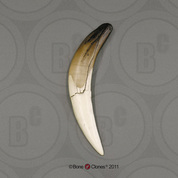
 KO-103 | Sabertooth Cat, populator single saber | Smilodon populator, found in eastern South America, was the largest of the three species of Smilodon. Although more robust than Homotherium, it may have been a greater leaper... |
 KO-103-P | Sabertooth Cat, populator sabers | Smilodon populator, found in eastern South America, was the largest of the three species of Smilodon. Although more robust than Homotherium, it may have been a greater leaper... |
 KO-114F | Short-faced Bear Femur | Short-faced Bear Femur- KO-114F. From our skeleton, SC-114... |
 KO-114H | Short-faced Bear Humerus | Short-faced Bear Humerus- KO-114F. From our skeleton, SC-114... |
 KO-115P | Short-Faced Bear Canine Teeth (pair) | The teeth of Arctodus simus are reminiscent of those of the lion. With large widely-spaced canines, useful for ripping skin and flesh, this bear seems to have been a true carnivore... |
 KO-115S | Short-Faced Bear Canine Tooth | A single Short-Faced Bear Canine Tooth... |
 KO-118 | Bison Antiquus Right Tibia | This right distal tibia displays two deep V-section chopmarks, suggesting blows from a heavy object. It has been suggested that this bison was butchered by humans... |
 KO-119 | Bison Antiquus Right Metatarsal | Right Metatarsal found associated with other skeletal elements during excavation of the Ayer Pond, Orcas Island Pleistocene site... |
 KO-132 | Cave Bear Canine | The Cave Bear lived in Europe from about 300,000 to 15,000 BC. It became extinct at about the time Cro-Magnon appeared. This canine is from a skull considered to be among the largest and most complete ever found... |
 KO-133 | Cave Bear Bacula | The Cave Bear occurred from England to the Caspian Sea. Its bones have been discovered in caves throughout Europe, where, in addition to its bones, its likeness has been found in cave paintings created by Neanderthals... |
 KO-136 | Australopithecus anamensis Cranial and Postcranial Set | First described by Leakey, et.al. in 1995, additional specimens were described by Leakey, et.al. in 1998. A complete morphology by Ward, Leakey and Walker was published in 2001 in the Journal of Human Evolution Volume 41, Issue 4, October 2001, Pages 255-368. The fossils described all date between 3.9 and 4.4 MYA... |
 KO-156 | Sarcosuchus imperator Supercroc Tooth | Sarcosuchus imperator (flesh eating crocodile) lived during the Cretaceous period (65 to 144 MYA) and, with an estimated body length of 40 feet, was one of the largest crocodiles that ever walked the Earth... |
 KO-157-S | Giant Ground Sloth Claw on Display Stand | Giant Sloths, which weighed up to 6,000 pounds, had very large, dangerous-looking claws... |
 KO-157 | Giant Ground Sloth Claw | 1.4 MYA. Genus Eremotherium first named by Spillmann 1948. Species eomigrans named by De Iullis and Cartelle in 1999... |
 KO-158 | Mastodon Molar | Fossils of Mastodons (including entire skeletons) have been found in many areas of North America, where they existed until about 10,000 years ago... |
 KO-197 | Woolly Mammoth Molar | Mastodons and Mammoths belong to the order Proboscidea, which also includes the African and Indian Elephants... |
 KO-198 | Columbian Mammoth Molar | The Mammoth's teeth had long ridges, suitable for grinding grass. As is the case with all Proboscideans, a worn down set of teeth would be replaced by another, for a total of six sets during their lifetime... |
 KO-199 | Mastodon Molar | The Mastodon's teeth have cone-shaped cusps and were built for chewing leaves and twigs. The Mastodon was shorter than the Mammoth and had much straighter tusks... |
 KO-212 | Sabertooth Cat Saber (single) | The sabertooth cat skull gives the impression that the sabers are so long, the cat could not get any food in its mouth. However, the jaw opens much wider than that of the modern cats... |
 KO-212P | Sabertooth Cat Sabers (pair) | The sabertooth cat skull gives the impression that the sabers are so long, the cat could not get any food in its mouth. However, the jaw opens much wider than that of the modern cats... |
 KO-218 | Large Megalodon Shark Tooth | The MEGALODON, prehistoric ancestor of the modern shark, appeared about 18 million years ago and became extinct... |
 KO-241-SE | Fossil Giant Elephant Bird Egg and Custom Display Stand | The stand is constructed from a cast of the longer leg bone and toes of the Elephant Bird Skeleton and comes with the egg... |
 KO-241-S | Fossil Giant Elephant Bird Egg Custom Display Stand | The Fossil Giant Elephant Bird Egg Custom Display Stand is also available alone without the egg... |
 KO-312-P | Homo ergaster pelvis assembly - KNM-WT 15000 | Homo ergaster KNM-WT 15000 Pelvis Assembly KO-313-P. From our H. ergaster skeleton... |
 KO-501 | Mastodon Vertebra | Mammut americanum, the Mastodon, became extinct about 10,000 years ago. The individual from which this vertebra (T3) came died approximately 12,450 years ago... |
 SC-012-A | Articulated Homo ergaster Skeleton | 1.6 MYA. This Homo ergaster skeleton was discovered in 1984 in Nariokotome, Kenya by Richard Leakey (and described as H. erectus)... |
 SC-012-D | Disrticulated Homo ergaster Skeleton, KNM-WT 15000 "Nariokotome Boy" | This Homo ergaster skeleton was discovered in 1984 in Nariokotome, Kenya by Richard Leakey (and described as H. erectus). This is the first skeleton dated before 100,000 years that is complete enough to get accurate measurements... |
 SC-012-PF | Homo ergaster pelvis and femur - KNM-WT 15000 | Homo ergaster pelvis and femur- KNM-WT 15000- SC-012-PF. From our Homo ergaster Skeleton SC-012. See below. ... |
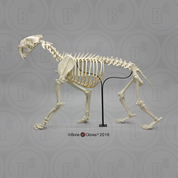
 SC-018A | Sabertooth Cat Smilodon Articulated Skeleton, Antique Finish | A full skeleton of the majestic Sabertooth Cat (Smilodon fatalis) from the La Brea Tar Pits in Los Angeles. Each bone - 231 pieces in all - was individually and meticulously molded by us... |
 SC-018A-D | Sabertooth Cat Smilodon Disarticulated Skeleton, Antique | A full skeleton of the majestic Sabertooth Cat (Smilodon fatalis) from the La Brea Tar Pits in Los Angeles. Each bone - 231 pieces in all - was individually and meticulously molded by us... |
 SC-018T-A | Sabertooth Cat Smilodon Articulated Skeleton, Tarpit Finish | This skeleton of the majestic Sabertooth Cat (Smilodon fatalis) from the La Brea Tar Pits in Los Angeles is available both articulated and disarticulated, completely ready for assembly... |
 SC-018T-D | Sabertooth Cat Smilodon Disarticulated Skeleton, Tarpit Finish | This skeleton of the majestic Sabertooth Cat (Smilodon fatalis) from the La Brea Tar Pits in Los Angeles is available both articulated and disarticulated, completely ready for assembly... |
 SC-019 | Articulated Neanderthal Skeleton | Available exclusively from Bone Clones®, this Neanderthal skeleton was reconstructed by Anthropologist Gary J. Sawyer, of the American Museum of Natural History and Blaine C. Maley, Anthropology Department, Washington University... |
 SC-019-D | Disarticulated Neanderthal Skeleton | Available exclusively from Bone Clones®, this Neanderthal skeleton was reconstructed by Anthropologist Gary J. Sawyer, of the American Museum of Natural History and Blaine C. Maley, Anthropology Department, Washington University... |
 SC-019-PF | Neanderthal Pelvis Femur Reconstruction | Available exclusively from Bone Clones®, this Neanderthal Neanderthal Pelvis Femur Reconstruction was reconstructed by Anthropologist Gary J. Sawyer, of the American Museum of Natural History and Blaine C. Maley, Anthropology Department, Washington University... |
 SC-036-A | Articulated "Lucy" Skeleton | Bone Clones® original reconstruction using previously prepared parts from our disarticulated version and adding some bones, such as all the neck vertebrae along with brass parts to indicate missing parts. Sets and individual skeletal bones available... |
 SC-036-AW | Articulated Walking "Lucy" Skeleton | By extrapolating from several sources, we created brass parts to indicate missing skeletal elements. Note that the arms and legs of the articulated skeleton in the walking position are rigid and fixed... |
 SC-036-D | Disarticulated Australopithecus afarensis-"Lucy", A.L.288-1-Skeleton | Discovered by Donald Johanson in 1974 in Ethiopia, "Lucy", at 3.2 million years has been considered the first human. This is now being challenged by the discovery of Kenyanthropus, described in 2001 by Leakey... |
 SC-114 | Short-Faced Bear Articulated Skeleton | Arctodus simus (Cope-1897), the Short-Faced Bear, became extinct approximately 11,000 years ago. This individual died approximately 28,000 years ago and was found in Alaska... |
 SC-114-D | Short-Faced Bear Disarticulated Skeleton | Arctodus simus (Cope-1897), the Short-Faced Bear, became extinct approximately 11,000 years ago. This individual died approximately 28,000 years ago and was found in Alaska... |
 SC-241-A | Articulated Elephant Bird Skeleton | The Elephant Bird is considered the largest bird in history. Possibly existing for nearly 2 million years in Madagascar, it faced extinction by the middle of the 17th century... |
 SC-241-D | Disarticulated Elephant Bird Skeleton | Bone Clones is proud to offer this magnificent specimen fully disarticulated. Each bone is cast separately, and is available... |
 SC-316-A | Articulated Odontopteryx gigas Skeleton | The bones of this Fossil Giant Bony-Toothed Bird were discovered in Oued Zem in northwestern Morocco and date from the Late Paleocene period (about 50 MYA)... |
 SC-316-D | Disarticulated Odontopteryx gigas Skeleton | The bones of this Fossil Giant Bony-Toothed Bird were discovered in Oued Zem in northwestern Morocco and date from the Late Paleocene period (about 50 MYA)... |
 SCB-012 | Articulated Xenosmilus Skeleton | Occurrence: Pleistocene (Irvingtonian) (1.7-1 MYBP), Florida. In 1981, remains of two specimens were found in the Haile limestone quarries in Alachua County, Florida. In 1994, they were suspect as possibly belonging to a new genus... |
| | | |