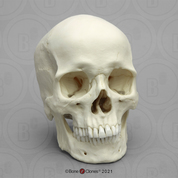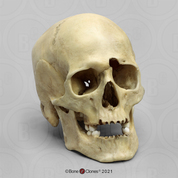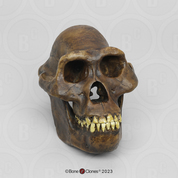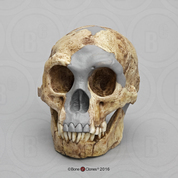


| Animal Skulls - Bone Clones began producing replica skulls in 1993. Our first skull replicas were the reproductions of endangered and extinct animals. All of our animal skulls are cast from original specimens. Because of our attention to detail, our skull products have become sought after in many professional fields including anthropology, anatomy, forensics, paleontology and zoology. Bone Clones’® are also playing a significant role in museum exhibits and becoming a part of the modern collections of these museums. Our collection of skulls also includes Modern Humans and Fossil Hominids. See these categories as well as subcategories containing the skulls of Great Apes, Birds, Sharks, Small Mammals, Fossil Cats and many more. |
Product # | Product Name | Description |
|---|---|---|
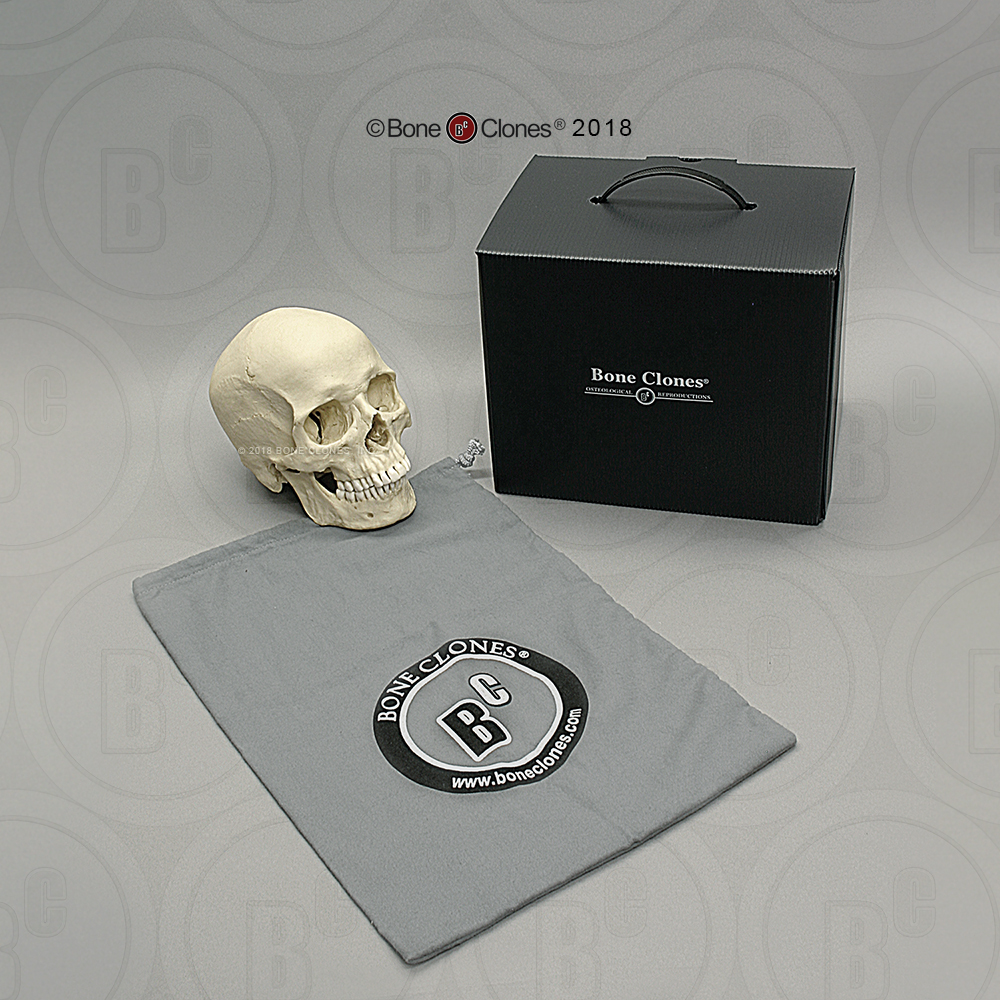
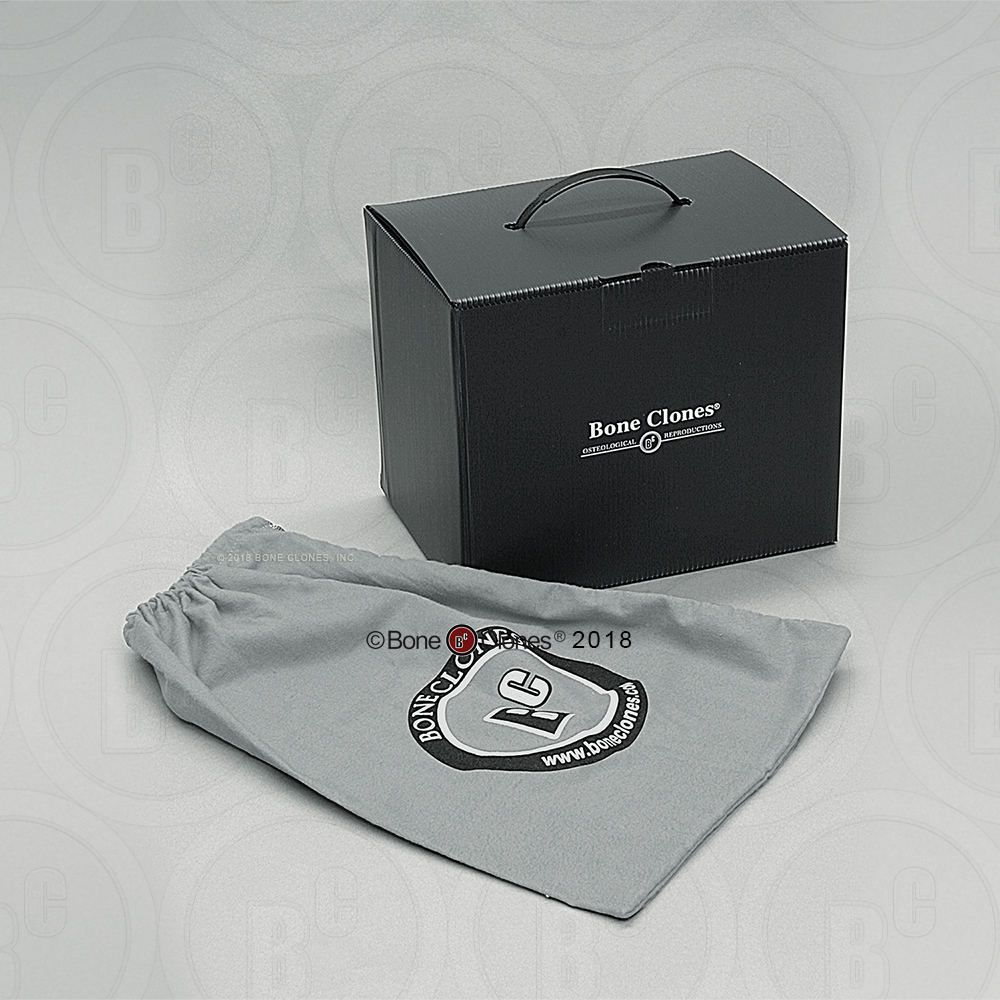
BA-100 | Storage Bag For Skulls | The simplest of our customers' requests took us the longest to produce, but here it is: a Bone Clones® bag for skulls. Useful for carrying and storing any number of Bone Clones® products... |
BC-001 | Male Gorilla skull | Gorillas are the largest of the world primates, reaching heights of 6 feet (when standing erect) and weights up to 400 pounds. Enormously strong, they have broad shoulders, thick muscular biceps, and forearms longer than their upper arms, with an arm span of over 8.5 feet... |
BC-002B | Bornean Orangutan Male Skull | Bornean and Sumatran Orangutans diverged about 1.5 million years ago and are classified as distinct species. Bornean Orangutans, as the name suggests, originate on the island of Borneo and are divided into 3 subspecies.. |
BC-002S | Sumatran Orangutan skull | Sumatran orangutans are restricted to a small area on the island of Sumatra and are considered in danger of imminent extinction... |
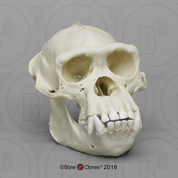
![]() BC-003 | Chimpanzee Skull | Native to the African rainforest, this social, diurnal animal weighs up to 120 lbs and grows to 5 1/2 feet. A robust and lively ape, the Chimpanzee is capable of insight, and has the ability to create and use tools... |
BC-004 | Siberian Wolf Skull | Siberian Wolf Skull. The Siberian wolf is the largest of the canids. This particular skull features powerful teeth... |
BC-005 | Clouded Leopard skull | The Clouded Leopard is a medium-sized feline weighing 25 to 50 pounds. Its coat is distinctly marked with large, dark bordered ellipses shaped like clouds. The upper canine teeth of the clouded leopard are proportionally much longer than other felines... |
BC-006 | Gila Monster Skull | Gila Monster Skull BC-006. This skull is cast from a large and old specimen with excellent teeth and epiderm ... |
BC-007 | Fruit Bat Skull | Pteropus poliocephalus is also known as an Old World Fruit Bat (or the Grey-Headed Flying Fox). It is found along the Australian coast. Bats are the only mammals to have evolved true flight. There are over 154 species of Old World fruit bats existing worldwide... |
![]() BC-008 | Siberian Tiger skull | The Siberian Tiger is one of six subspecies of tiger alive today, and the largest member of the cat family. This nocturnal hunter can be found in the cold forests of eastern Russia and northeastern China... |
![]() BC-009 | Dwarf Crocodile Skull | Dwarf Crocodile Skull BC-009. An evolutionary link between prehistoric dinosaur-like reptiles and present day birds, this species of crocodile is... |
BC-010 | Male Mandrill Baboon skull | Mandrills are the world's largest simian species with adult males achieving weights of 120 pounds. Male mandrills are also arguably the most colorful of all primates... |
BC-011 | Giant Anteater Skull | The Giant Anteater, found in Central and South America, has a very distinctive appearance, high-lighted by its curved, tubular snout. It reaches lengths of more than 7 feet and weights beyond 80 pounds... |
![]() BC-012 | Tasmanian Wolf Skull | The Thylacine is also known as the Tasmanian Tiger (due to its striped fur) or the Tasmanian Wolf although it is, in fact, a marsupial... |
![]() BC-013 | Tasmanian Devil Skull | The Tasmanian Devil is the largest extant marsupial carnivore. It is a hunter/scavenger with a short, compact body and a large, powerful head. It is said to rival the spotted hyena, pound for pound, in jaw strength... |
![]() BC-014 | Sea Otter Skull | Sea Otter, skull BC-014. Inhabiting the seas and kelp beds of North America, the otter is a highly intelligent, playful, inquisitive and friendly mamm ... |
BC-015 | Cougar Skull | Known by many names, for example, Puma, American Lion, Deer Tiger, Mexican Lion, Panther, Painter, Mountain Lion, and Catamount, this giant cat makes its home in mountains, deserts and jungles throughout North and South America... |
BC-017 | Howler Monkey Skull | Howler Monkey Skull BC-017 This skull is from a male howler monkey, a large platyrrhine (flat-nosed) New World simian with a strong prehensile tail... |
BC-018A | Sabertooth Cat Smilodon Skull Replica Antique Finish | One of the finest specimens from the Los Angeles County Museum of Natural History. Great care was taken when we cast this piece to preserve every detail and nuance of the original specimen... |
![]() BC-018T | Sabertooth Cat Smilodon Skull Replica Tarpit Finish | One of the finest specimens from the Los Angeles County Museum of Natural History. Great care was taken when we cast this piece to preserve every detail and nuance of the original specimen... |
![]() BC-019A | American Lion Skull Antique Finish | Felis atrox was the largest lion to have ever existed, this individual weighing an estimated 900 pounds. Found only in the western hemisphere, this 14,000 y.o. specimen came from the La Brea tar pits... |
BC-019T | American Lion Skull Tarpit Finish | Felis atrox was the largest lion to have ever existed, this individual weighing an estimated 900 pounds. Found only in the western hemisphere, this 14,000 y.o. specimen came from the La Brea tar pits... |
![]() BC-020A | Dire Wolf Skull Antique Finish | Same skull as our BC-020T, but with a lighter Antique Finish... |
![]() BC-020T | Dire Wolf Skull Tarpit Finish | Thriving during the Pleistocene, the Dire Wolf is not a direct ancestor of any of today's known species of canine. They co-existed in North America with Grey Wolves for about 100,000 years. Dire Wolves had short, thick legs, a larger, broader skull... |
BC-021 | Kodiak Grizzly Bear, X-large Skull | The grizzly, being the largest of all bears, reaches a length of 10 feet and may weigh up to 1300 lbs. It is the largest carnivore... |
BC-022 | Great Dane Skull | The Great Dane (Canis familiaris) is thought to have originated from a cross between Asiatic mastiffs and Irish wolfhounds sometime during the 5th century A.D. They are second only to the Irish wolfhounds in size and height... |
![]() BC-024 | Maned Wolf Skull | Maned Wolf Skull. The South American maned wolf is not a true wolf. These rare, fox-like canids stand about 3 feet at the shoulder and have extremely... |
![]() BC-025 | Giant Panda Skull | Giant Pandas with their distinctive black and white coloration are favorites the world over. They are cousins to bears with their lineages splitting off millions of years ago. The most specialized herbivore of all carnivores, their diet consists of 99 percent bamboo... |
BC-026 | Duck-Billed Platypus Skull | A platypus skull is broad and flat. It has a flexible bill covered with a thin membrane of skin that contains electro-sensitive cells... |
![]() BC-027 | Komodo Dragon Skull | Komodo Dragon skull BC-027. Komodo dragons are the heaviest and longest of the world's lizards growing to a length of 10 feet and weighing upwards of 300 pounds. Their skulls are very similar to the extinct aquatic dinosaurs known as Mosasaurs... |
BC-028 | Tuatara Skull | Restricted to islands off the coast of New Zealand, the highly protected Tuatara has remained virtually unchanged for some 130 million years. It is the sole survivor of a reptilian order which became virtually extinct some 70 million years ago and is now represented by a single genus with one species... |
BC-029 | Hyacinth Macaw Skull | Hyacinth Macaw Skull BC-029. Hyacinth macaws are striking birds with long, pointed tail feathers and a huge, hooked black beak. Their plumage is a dramatic and deep cobalt blue overall with the head a slightly lighter color than the body... |
![]() BC-030 | Dinictis Skull | Dinictis lived on the plains of North America 35-40 m.y.a. Ancestors to modern cats, this ancient skull is reminiscent of today's clouded leopard skull... |
BC-032 | Hyena Skull | Hyena Skull, Unusual among mammals, the female Spotted Hyena is significantly larger than the male and more aggressive... |
BC-033 | Dolphin Skull | The bottlenose dolphin is what comes to mind for most people who picture a dolphin ("Flipper" is a bottlenose dolphin). With a bigger brain than humans, they are considered to be very intelligent and may have complex language... |
![]() BC-034 | Giraffe Skull | The Giraffe, unlike most animals, is born with horns intact, although they are folded onto the skull to ease their passage during birth. These horns, called ossicones, are not truly horns, but are made of bone and covered with skin and hair... |
BC-035 | Female Western Lowland Gorilla Skull | Wild female gorillas stand 3 1/2 to 5 feet tall and weigh 150 to 220 pounds. Their skulls are less massive than the males, having a reduced nuchal crest and lacking a sagittal crest... |
BC-036 | Male Gorilla skull (extra large) | Gorillas are the largest of the world primates. The adult male gorilla stands 4 to 6 feet tall when standing erect on slightly bowed legs. Wild males can weigh between 300 and 400 pounds... |
BC-037 | Hippopotamus Skull | Hippopotamus were once common throughout all of sub-Saharan Africa but are now primarily restricted to the Nile River Valley of East Africa. They prefer moderately deep bodies of water with adjacent reed beds and plentiful grasslands... |
![]() BC-038 | Nile Crocodile Skull | The Nile crocodile, whose body shape has remained fairly constant over the last 65 million years, is a member of the group called archosaurs. Other members include dinosaurs, flying reptiles and ancestors of the world's birds... |
BC-039 | Okapi Skull | Though not discovered by modern man until 1901, the Okapi is essentially a short-necked forest giraffe surviving since the Pleistocene. The giraffe's only cousin, they can be found only in the tall dense primary forests of the remote Ituri Forest of the Democratic Republic of Congo... |
BC-040 | Thoosuchus Skull | Thoosuchus were semi-aquatic batrachomorphs that lived worldwide over 200 million years ago. Similar in appearance to salamanders, thoosuchus are the most likely ancestors of the modern day tail-less amphibians we call frogs... |
BC-041 | Warthog skull | This amazing Warthog skull holds the world record for the largest warthog tusks. Its beautifully curved upper tusks are over 20 inches long, giving its skull an almost sculptural appearance. |
BC-042 | Meerkat Skull | Meerkats, or suricates, are highly social members of the mongoose family. They live in multi-family groups of 5 to 30 members, known appropriately enough as a mob or gang... |
BC-043 | Harpy Eagle Skull | Harpy Eagle Skull BC-043. The largest and fiercest of the New World raptors, Harpy Eagles can weigh up to 18 pounds and have a 6.5 to 7-foot wingspan. ... |
BC-044 | False Killer Whale Skull | Growing up to 20 feet long, this species has the largest range of all Cetaceans... |
BC-045 | Gavial Skull | The Gavial, also called the Indian Gharial, is one of the largest (up to 23 feet) and most unusual of all the crocodilians. Characterized by its long, slender snout, it is equipped with 106 to 110 sharp spike-like teeth, well suited for their preferred diet of fish... |
BC-046 | Manatee Skull | Manatees are more closely related to Elephants, Hyraxes and Aardvarks than to seemingly similar cetaceans (whales and dolphins). While this aquatic mammal is largely herbivorous, it may sometimes feed on fish or invertebrates... |
![]() BC-047 | Female Siamang Skull | Siamangs are found in Sumatra and Malaysia. They are the largest of the lesser apes, standing about three feet tall... |
BC-048 | Common Vampire Bat Skull | Common vampire bats are small to medium sized bats, 2.5 to 3.5 inches in length with a wingspan of about 8 inches. Weighing between 1 to 2 ounces, they can consume 60% of their body weight in blood... |
BC-049 | Colugo, Flying Lemur Skull | Little is known about these odd little nocturnal 2 to 4 pound animals called Colugos. They were once erroneously thought to be related to lemurs and are still commonly (but wrongly) called Flying Lemurs, but they are neither lemurs nor do they fly... |
![]() BC-050 | Tarsier Skull | Small, insectivorous, nocturnal tree-dwelling primates, tarsiers receive their name from their greatly elongated tarsus, or ankle, bones. This adaptation allows them to make prodigious, sure-footed leaps through the trees... |
BC-051 | Sumatran Rhinoceros Skull Only | Sumatran Rhinoceros Skull BC-051. Highly endangered, there are, perhaps, only 300 left in the world. The Sumatran Rhinoceros is considered to be the oldest ... |
BC-051H | Sumatran Rhinoceros skull and Horns | Sumatran Rhinoceros Skull with horns BC-051H. Highly endangered, there are, perhaps, only 300 left in the world. The Sumatran Rhinoceros is considered to be the oldest ... |
BC-052 | Cuban Solenodon Skull | The Cuban Solenodon is found only in Cuba. The family Solenodontidae contains one surviving genus (Solenodon) and two endangered species, both of which we are proud to offer... |
BC-053 | Haitian Solenodon Skull | The Haitian Solenodon, also known as the Hispaniolan Solenodon, lives only on the island of Hispaniola (Haiti and the Dominican Republic)... |
![]() BC-054 | African Lion Skull | The African Lion is both the most sexually dimorphic (with physical differences) of the big cats and the largest of African carnivores. Adult lions can be over 8 feet long and weigh between 250 and 500 pounds... |
BC-055 | Black-footed Ferret Skull | Black-footed Ferret Skull BC-055. Related to Sea Otters, this ferret is considered to be the rarest mammal in North America. There were only 31 indi ... |
BC-056 | Snow Leopard Skull | Leopard, Snow, skull BC-056 Living in the mountain ranges of Central Asia from China to the Himalayas, Snow Leopards are highly endangered in the wild ... |
BC-057 | Jaguar Skull | The Jaguar, a powerful climber and swimmer, is the largest cat on the North American continent. This tawny cat with dark rosettes closely resembles its cousin, the leopard, which inhabits a different continent... |
BC-058 | White Rhino Skull Without Horns | The skull is available without horns, and the horns may be purchased separately as a set... |
BC-058H | White Rhino skull with Horns | White Rhino Skull BC-058. Weighing around 3000 pounds, the name â€Å"White Rhino†is actually a misnomer, an incorrect translation of a word that actual ... |
BC-060 | African Leopard Skull | Found in both Asia and Africa, these large and beautiful cats are mostly nocturnal and solitary. They are endangered but breed well in ... |
BC-061 | Capybara Skull | Capybara Skull BC-061. The capybara is the largest rodent in the world. This skull comes from an exceptionally large individual, weighing anywhere fr ... |
BC-062 | Penguin Skull | Penguin Skull BC-062. The Magellan Penguin comes from southern South America and is a mid-sized penguin. Outside of Antarctica, the Magellan lives par ... |
BC-063 | Polar Bear Skull | Polar Bears are extremely large predators and dangerous to humans. These bears are often found on ice flows... |
![]() BC-064 | Loggerhead Sea Turtle Skull | Found in large numbers in the Atlantic from Florida to The Carolinas, Loggerhead Sea Turtles are considered threatened, due to the over hunting for food... |
BC-065 | American White Pelican Skull | American White Pelican Skull BC-065. Pelicans are among the largest and heaviest birds in the world. And when it comes to their beak: as Ogden Nash ... |
![]() BC-066 | Koala Skull | Koalas reportedly have one of the smallest brains relative to body size of all mammals. Their prune size brain halves don't even physically touch and still only occupy just 60% of the available space in their thick furry skull at that... |
BC-067T | Sabertooth Cat, Deluxe Smilodon Skull Tarpit BC-067T | Deluxe Smilodon Skull Tarpit Finish BC-067. Found in the 1930's across the street from the La Brea Tar Pits. The site was immediately clo ... |
![]() BC-067A | Sabertooth Cat, Deluxe Smilodon Skull Antique BC-067A | Our large deluxe Sabertooth Cat is now also available in antique finish... |
BC-068 | Bald Eagle Skull | Bald Eagle Skull BC-068. Native to North America and our national symbol, the Bald eagle's wingspan can reach over 7 feet. Primarily fish eaters, th ... |
![]() BC-069 | Vervet Monkey Skull | Vervet Monkey Skull BC-069 The Vervet or Green monkey lives in the woodlands and savannahs of Africa. It mainly feeds on fruit, although occasionally ... |
BC-070 | Rock Hyrax Skull | While it may look like a rodent, such as a rabbit or a guinea pig, the rock hyrax is actually more akin to elephants and manatees... |
![]() BC-071A | Giant Fossil Beaver Skull Antique Finish | Belonging to the Pleistocene era, Rancholabrean epoch, the Giant Beaver became extinct about 10,000 years ago... |
![]() BC-071T | Giant Fossil Beaver Skull Tarpit Finish | Belonging to the Pleistocene era, Rancholabrean epoch, the Giant Beaver became extinct about 10,000 years ago... |
![]() BC-072 | Great Horned Owl Skull | The Great Horned Owl is found throughout North, Central and South America. It is the heaviest of the Owls and is about 2 feet long with tufts above its ears that resemble horns, hence the name... |
BC-073 | Golden Eagle Skull | Golden Eagle Skull BC-073. North America's largest bird of prey with a wingspan of over 7 feet. Often hunting in pairs, each bird can carry 8 pounds ... |
BC-074 | Raven Skull | Raven Skull BC-074. The largest of the crow family, the raven often mates for life and can have a lifespan of 50 years. They are extremely intelligent... |
BC-075 | Crow Skull | Crow Skull BC-075. One of the most common birds in North America, they are very social and protect each other with various warning cries. We grateful ... |
BC-076 | Pygmy Hippo Skull | Pygmy hippos closely resemble their larger relatives the Nile hippo, standing 30 to 35 inches high at the shoulder, weighing 350 to 550 pounds and measuring about 5.5 feet from snout to vent... |
BC-077 | California Condor Skull | California Condor Skull BC-077. The California Condor is the largest flying bird in North America, having a wingspan of 9 1/2 feet and weighing up t ... |
BC-078 | Red-tailed Hawk Skull | The Red-tailed Hawk is distributed throughout North and Central America. If the weather is not too harsh, the hawk will stay in one area throughout the year... |
BC-079 | Cheetah Skull | Africa's 10,000-12,000 remaining cheetahs are found only in scattered areas of sub-Sahara, with a remnant population of less than 100 in Iran. Their long legs, deep chest, long flexible spine and semi-retractable claws provide them the resources to claim the title of "fastest land animal"... |
![]() BC-080 | Tamarin skull | One of the smallest monkeys in the world, the Cotton-top Tamarin (also known as the Cotton-top Marmoset) ranges from Central to South America... |
![]() BC-081 | Pygmy Marmoset Skull | Found throughout most of South America, the Pygmy Marmosets are the smallest of all living monkeys. Their diet consists... |
BC-082 | Elephant Shrew Skull | Also known as Sengi or Black and Rufous, the shrew belongs to the ancient order Afrotheria, which includes a wide variety of dissimilar looking animals who originated from a common African ancestor over 100 million years ago... |
BC-083 | Tree Shrew Skull | The tree shrew, which resembles a very small squirrel with a long snout, is not a shrew and does not entirely live in trees. More closely related to primitive prosimians, they have a higher brain-to-body mass ratio than humans... |
![]() BC-084 | Temple Monkey, Hanuman Langur Skull | Found in Bangladesh, India and Sri Lanka, they are also known as temple monkeys as they are sacred in India, traveling with the holy men... |
BC-085 | Harbor Seal Skull | Known also as the spotted seal, Harbor Seals can reach 6 feet long and weigh up to 375 pounds... |
BC-086 | Lesser Panda Skull | The lesser panda is also known as the red panda. It is found throughout the Himalayas. Although classification is still be... |
![]() BC-087 | Ring-tailed Lemur Skull | These beautiful animals are well known for their striking black and white tail and walking on their hind legs... |
BC-088 | Pika Skull | Pikas may sometimes be called Rock Rabbits but they aren't actually rabbits. They are in the same order as rabbits and hares (Lagomorphs) but are classified as a different family... |
BC-089 | Giant Armadillo skull | The Giant armadillo is classified in the order Xenarthra, which means "strange joint," an apt description of their unusual cervical vertebrae. Xenarthra is a diverse mammalian group that originated in South America and includes the extinct giant armored gylpodont and the ground sloth... |
BC-090 | Wolverine skull | Related to ferrets and weasels, Wolverines are the second largest living member of the family Mustelidae... |
BC-091 | Chinese Water Deer skull | Originally from China and Korea, Chinese Deer have been introduced and are now wild in England and France. They are relatively small in size and lack antlers. The most startling feature, especially in the males, is the extraordinarily large canine teeth... |
![]() BC-094 | Goliath Frog Skull | Goliath frogs inhabit swiftly flowing rivers in the dense humid rainforests of coastal Cameroon and Equatorial Guinea. Weighing up to 7 pounds, they measure 12.5 inches from snout to vent and almost 3 feet when outstretched... |
BC-096 | Peregrine Falcon Skull | The word peregrine is Latin for 'wanderer' and is an apt description for this raptor, which may migrate over 15,000 miles in a year. Peregrines are the best-known species of falcon, having been used for hunting for hundreds of years... |
BC-097 | Dugong skull | The Dugong belongs to the order Sirenia, which includes Manatees. Sirenians belong to a group called subungulates, which includes elephants and hyraxes, two animals that by appearances and habitat would seem to have nothing in common... |
BC-098 | Two-Toed Sloth Skull | Two-Toed Sloth Skull BC-098. Two-toed sloths are perhaps more heterothermic than any other mammal. Their body temperatures fluctuate from as low as 24 degrees C to as high as 33 degrees... |
BC-099 | American Black Bear Skull | Bear, American Black, skull BC-099 Found from Alaska to Mexico, the American Black Bear thrives. Reaching 6 feet and over 300 pounds, they are skillfu ... |
BC-099E | Economy American Black Bear Skull | Found from Alaska to Mexico, the American Black Bear thrives. Reaching 6 feet and over 300 pounds... |
BC-100 | White-tailed Deer Doe Skull | White-tailed deer inhabit tropical and temperate deciduous forests ranging from Canada through much of South America. They are the most common ungulate in North America and the number one large game animal for hunters... |
![]() BC-101 | Common American Beaver skull | The largest rodent in North America, the semi-aquatic beaver can weigh up to 60 pounds. It is an excellent swimmer, using its webbed back feet and paddle-like tail to maneuver through the water... |
BC-102 | Machairodus giganteus Skull | Machairodus giganteus. Age: Late Miocene, China. This cat lived approximately 4.5 to 5 million years ago and was about the size of a lion, but with a longer muzzle and narrower skull. Machairodus is an excellent example of a saber-toothed cat... |
![]() BC-103 | Smilodon populator Skull | Smilodon populator lived in the eastern part of South America. The three species recognized in the Smilodon genus became extinct only about 10,000 years ago... |
![]() BC-104 | Cave Lion Skull | Cave Lion Skull BC-104 The Cave Lion became extinct approximately 15,000 years ago. These large, conical-toothed cats of the North American Ice Age ... |
BC-105 | Alligator, 12 inch, Skull | All alligators (the American and Chinese species) are crocodilians. In 1967 American alligators were one of the first animals to be listed as an endangered species. Their population recovered to the extent that they were removed from the list... |
BC-106 | Megantereon nihowanensis Skull | Megantereon cultridens (nihowanensis). Late Miocene to earliest Pleistocene. ( 6 - .9 mya) China. The genus Megantereon has a very long history in the fossil record... |
BC-108 | Walrus Skull with Tusks | The thick-skinned walrus may weigh approximately 900 to 3,500 pounds, with males being larger than females. The tusks of a walrus can grow up to one meter long. These tusks have many uses: fighting, eating, cutting ice, and allowing them to remain stable while asleep... |
![]() BC-109 | Owl Monkey Skull | Owl Monkey Skull BC-109 The only truly nocturnal primate is found in the northern part of South America. The owl monkey is a small creature with l ... |
BC-112 | Pileated Woodpecker Skull | Pileated Woodpecker Skull BC-112. The Pileated Woodpecker is the largest woodpecker found in most of North America. Because of its size and chisel-s ... |
![]() BC-113 | Xenosmilus hodsonae Skull | Xenosmilus hodsonae Skull BC-113 Xenosmilus hodsonae Occurrence: Pleistocene (Irvingtonian) (1.7-1 MYBP), Florida... |
![]() BC-114 | Short-Faced Bear Skull | Bear, Short-Faced, skull BC-114. Arctodus simus (Cope-1897), which is more closely related to the Andean Bears, Tremarctos than to Ursus, have been ... |
![]() BC-117 | Juvenile Machairodus giganteus Skull | Juvenile Machairodus giganteus Skull BC-117 . Age: Late Miocene, China. Living approximately 4.5 to 5 million years ago and about th ... |
BC-118 | Python Skull | Python Skull BC-118. The reticulated python gets its name due to its skin pattern which resembles a geometrical network. This non-venomous constrict ... |
BC-119 | Anaconda Skull | Anacondas are the world's heaviest snakes, growing to lengths of over 29 feet and weighing up to 550 pounds with a girth of 12" or more. These South American giants primarily inhabit tropical forests, savannas, marshes and wetlands and spend much of their time in the water... |
![]() BC-120 | Pacu (Tambaqui) Skull | Pacu (Tambaqui) Skull BC-120. The Tambaqui (also known as Pacu) lives in the deep waters of the Amazon and Orinoco river basin of South America... |
BC-121 | Gaboon Viper Skull | Native to the western equatorial Africa, the Gaboon viper is the largest and heaviest member of viperine snakes, reaching lengths of almost 6 feet and weighing almost 30 pounds... |
BC-122 | Chinese Giant Salamander Skull | One of the world's largest amphibians, the Chinese Giant Salamander can reach lengths of almost 5 feet and weigh up to 50 pounds. They have a broad, flat head with tiny, lidless eyes set on top. The Vomerine teeth parallel the maxillary tooth rows in a long arc... |
![]() BC-123 | Female Bonobo Skull | Sometimes called the pygmy chimp, the Bonobo is a species distinct from the "common" chimp, P. troglodytes. Its behavior, especially among females, is thought to resemble humans’ more than the common chimp’s... |
BC-124 | Mountain Gorilla Skull | Mbongo, a Mountain Gorilla, was born in the high mountains of what was once the Belgium Congo and is now Zaire. He and another young gorilla named Ngagi were captured in 1930 by the famous explorers, Martin and Osa Johnson... |
![]() BC-125 | Horse skull | The large and slender horse skull has long, broad, tapering nasals. At the front of the mouth are large incisors, designed for cropping grass... |
![]() BC-126 | Saluki Skull | The graceful and elegant Saluki, also known as the Arabian Hound or the Persian Greyhound, may be the oldest known breed of domesticated canine. Images of the dog can be found in ancient carvings (dating back to 14,000 BC) and other artwork... |
BC-127 | Airedale Skull | The Airedale is sometimes called the King of Terriers, as it is the largest of terriers. The Airedale is a formidable hunter of water rats and other larger feathered and furred game. It sealed its reputation as a valuable dog during WWI... |
BC-128 | English Bulldog Skull | Although it is a short dog (standing about 12-15"), the Bulldog is wide and stocky, weighing 50-55 lbs., giving an overall appearance of great stability. The thick body is matched by a broad head with a short, pug muzzle ending with a wide, black nose... |
BC-129 | Alligator, 20 inch Skull | Alligators have been around for over 200 million years and are integral to the health of their wetland homes. Their presence insures a healthy environment for many plants and animals... |
BC-130 | Gavialosuchus Skull | Discovered in 1990 in a phosphate mine in Polk County, Florida, this Gavialosuchus skull is considered the largest, most complete specimen ever found... |
BC-131 | Common House Cat Skull | The Common House Cat originated from African Wildcats (Felis silvestris lybica) and has been associated with humans for over 9,500 years. Their domestication was an offshoot of their value for ridding human grain storage areas of large numbers of rats and mice... |
![]() BC-132 | Cave Bear Skull | The Cave Bear lived in Europe from about 300,000 to 15,000 BC. It became extinct at about the time Cro-Magnon appeared. This particular skull is among the largest and most complete ever found... |
![]() BC-137 | Rhesus Macaque Skull | Ranging throughout Asia from India to southern China, humans are the only primate species with a broader geographic range than rhesus monkeys. A medium-sized simian, adult males can weigh up to 20 pounds while females may weigh 10-14 pounds... |
BC-134 | Sandhill Crane Skull | Sandhill Cranes are common from Alaska through the US and Cuba and Siberia. Both parents care for their young for about 10 months and have elaborate courtship dances... |
![]() BC-136 | Mouse Lemur Skull | The Mouse Lemur, which inhabits Madagascar (as do all lemurs), is the world's smallest primate. Its roughly 5-inch tail is double the length of its body and head. It spends most of its life in trees... |
![]() BC-137 | Rhesus Macaque Skull | Ranging throughout Asia from India to southern China, humans are the only primate species with a broader geographic range than rhesus monkeys. A medium-sized simian, adult males can weigh up to 20 pounds while females may weigh 10-14 pounds... |
BC-138 | Parson's Chameleon | Parson's Chameleons are the largest of the Old World chameleons and can grow to total lengths of 2-2 ÂÂ1/2 feet. The large skulls of the Male Parson's Chameleons have strong bony ridges and two warty "horns," which they use to joust each other for dominance... |
![]() BC-139 | French Bulldog Skull | The French Bulldog, affectionately called "Frenchie," is essentially a mini-English Bulldog. It is thought by some that the smaller specimens of the English Bulldog were taken aboard ship to France because they could be more easily hidden... |
BC-140 | Gigantopithecus blacki | Whether Gigantopithecus blacki, known today as the mysterious Bigfoot, continues to exist hidden in forests today remains a mystery. Licensed exclusively to Bone Clones® by the estate of Grover Krantz... |
![]() BC-141 | Meganthropus | This Meganthropus Skull Reconstruction was created by Dr. Grover Krantz, a noted scholar of physical and cultural anthropology and an active Professor of Anthropology at Washington State University until shortly before his death... |
BC-142E | Economy Raccoon Skull | The raccoon is known for its famous black bandit mask around its eyes and the black rings on its tail... |
BC-143E | Economy Coyote Skull | The coyote is found from Central America through central Canada and into Alaska. Belonging to the family Carnivora, it can be distinguished from domestic dogs by its pointed ears and drooping tail... |
BC-144E | Economy Gray Fox Skull | The Gray Fox is nicknamed The Tree Fox due to its ability to climb trees and leap from branch to branch with catlike agility... |
![]() BC-145E | Economy White-tailed Jackrabbit Skull | Found throughout western and central Canada and the United States, white-tailed jackrabbits prefer open grasslands, pastures, and open fields. Jackrabbits are hares and hares are rabbits, but not all rabbits are hares... |
BC-146E | Economy Bobcat Skull | The bobcat is heavily populated in the southeastern United States. Their range extends from southern Canada throughout the US to southern Mexico... |
BC-147 | Red Wolf Skull | The Red Wolf is larger than the Coyote and smaller than the Gray Wolf. Some authorities debate its identity considering it the result of the cross-breeding between the Coyote and Gray Wolf... |
BC-148E | Economy Skunk Skull | Black with wide, white stripes from head to tail and a thin white stripe on the muzzle, the Striped Skunk is found from Central Canada to Northern Mexico... |
BC-151 | Ruby-throated Hummingbird Skull | The ruby-throated hummingbird is mostly found in eastern and central US, but breeds throughout the central US and Central America. Often found in gardens, it winters in tropical rainforest... |
BC-153 | Barn Owl Skull | The barn owl derives its common name from its habit of nesting and roosting in secluded barn lofts, though it will take refuge in any secluded spot. It has a white, heart-shaped face, a round head and no ear tufts... |
![]() BC-154 | Barred Owl Skull | A medium-sized owl, with a yellow beak, atypical brown eyes, a rounded head lacking ear tufts, the barred owl is named for its barred and spotted cinnamon brown, tan and white plumage... |
BC-155 | Burrowing Owl Skull | Burrowing Owls reside in open dry grasslands and deserts of North and South America, primarily in the west, although also in the higher, drier parts of south central Florida... |
BC-156 | Sarcosuchus imperator Supercroc Skull | Sarcosuchus imperator (flesh eating crocodile), nicknamed Supercroc, lived during the Cretaceous period (65 - 144 MYA). With an estimated body length of 40 feet, and a skull over 5 1/2 feet long, Supercroc is one of the largest crocodiles that ever walked the Earth... |
BC-157E | Economy Javelina Skull | The Javelina (pronounced Ha - va - LEE - na), or Collared Peccary, is a smallish pig-like animal native to portions of South, Central and southwestern North America (and is the only pig-like wild animal native to the United States)... |
BC-158E | Economy Ringtail Skull | The Ringtail is a cat-sized carnivore with a fox-like face, large eyes and ears, short legs and a long, ringed tail. One of the smallest (and most carnivorous) members of the Procyonid family... |
BC-159 | Woolly Mammoth Skull | Mammoths belong to the order Proboscidea, which also includes the American Mastodon and the African and Indian Elephant. The larger species of Mammoth, which appeared about 4 MYA, became extinct about 10,000 years ago... |
BC-160 | Mosasaur Platecarpus planifrons Skull | Platecarpus planifrons, a medium-sized mosasaur that lived approximately 86 MYA during the late Cretaceous Period. One of only a few known, this specimen is the best in existence. Complete with pterygoid teeth... |
BC-160-N | Mosasaur, Platecarpus Skull and Neck | Platecarpus planifrons, a medium-sized mosasaur that lived approximately 86 MYA during the late Cretaceous Period. One of only a few known, this specimen is the best in existence. Complete with pterygoid teeth... |
BC-161 | Great Blue Heron Skull | The largest heron species in North America, the great blue herons stand 4 feet tall with long, flexible necks and a 7-foot wingspan. Its back, wings and belly are a bluish gray, while its face is white and long bill is yellow... |
BC-162 | Horned Puffin Skull | Horned Puffins are named for the fleshy, horn-like growth above their eyes. Puffins are also known as the Sea Parrot because of the large yellow, orange and red beaks they sport... |
![]() BC-163 | Aye-aye Skull | From the rainforests of Madagascar, the Aye-Aye is, perhaps, the strangest of the primates. They were first classified as rodents due to their rodent-like incisors... |
BC-164 | Muntjac Skull | Also called the Barking Deer, the Muntjac barks when predators are near. They are relatively common in their home range of China and Taiwan with over 600,000 individuals... |
BC-165 | Kiwi Skull | Living in the New Zealand forests, the Brown Kiwi (as well as all Kiwis) produces the largest egg, proportional to its size, of any bird. The egg weighs around one pound and practically fills the entire body cavity... |
BC-166 | Osprey Skull | Ospreys are one of the most abundant birds of prey living on all continents except Antarctica. Among the reasons for their success is that they are able to build their large nests practically anywhere... |
BC-167 | Northern Cardinal Skull | Northern Cardinals are quite prolific from Canada through North and Central America, where they adapt well to humans and moderate temperatures... |
BC-168 | American Robin Skull | American Robins are common throughout North and Central America, with their range extending to Alaska. They live in human gardens and fields but prefer dense wooded areas to build nests and raise their young... |
BC-169 | Yellow Billed Cuckoo Skull | The Yellow-billed Cuckoo, found throughout North and South America, is often seen near lakes and streams in woodland areas. This medium-sized bird is generally solitary, but pairs up during breeding season... |
BC-170 | Blue Jay Skull | The Blue Jay is a large songbird (9-12 inches long) found from Texas to Florida and up through Southern Canada. It is easily identified by its distinctive coloring-various shades of bright blue on its upperparts... |
BC-171 | Common Snipe Skull | The Common Snipe is a wading bird found in wet, grassy areas in North and South America, Europe, Northern Africa, and Asia. The Common Snipe uses its remarkably long, pointed and straight bill to poke around in the mud for snails... |
BC-172 | Mexican Wolf Skull | The Mexican wolf is the smallest of the North American wolves. Highly endangered, its range until recent times was from Texas, New Mexico, and Arizona through central Mexico... |
BC-173 | Toco Toucan Skull | From eastern South America, the Toco Toucan is the largest member of its family, Ramphastidae. They live high in the treetops and are noted for their large beautiful yellow bill... |
BC-174 | Wreathed Hornbill Skull | The Wreathed Hornbill is a large (4-8 pounds) black bird with a yellowish tail, red eyes, and a long, thick beak topped with a small 'wreathed' casque with up to 9 ridges. The male has a bright yellow inflatable throat pouch, while the female's is blue. |
BC-175 | Black Hornbill Skull | Asian Black Hornbills are medium-sized hornbills found primarily in lowland and swampland forests over Malaysia, Indonesia and Thailand. Hornbills are named for their horn shaped beaks often topped by a large hollow chamber called a casque... |
BC-176 | Scarlet Ibis Skull | The Scarlet Ibis occurs in South America and on islands in the Caribbean. Like all ibises, they are wading birds with long legs and a long, curved bill... |
BC-177 | Roseate Spoonbill Skull | The Roseate Spoonbill, found in the southeast US from Florida to Texas, is a gregarious pink bird with a naked head, red legs, and a long bill ending in a spoon-like paddle... |
BC-179 | King Cobra Skull and base | The King Cobra is the largest of all the cobras, reaching a length of 18 feet. Their home range is India, Indonesia, Malaysia and the Philippines. They are very aggressive and guard their caves and home range... |
BC-184 | Ganges River Dolphin Skull | Living in the muddy water systems of India, Nepal, Bhutan, and Bangledesh, The Ganges River Dolphin (also known as Susu) is almost blind and is believed to be able to only see light and dark. Although sometimes found in small groups, they are mostly considered solitary. Their pointed slender teeth are ideal for capturing small fish while tooling around the river bottoms... |
BC-186 | Pit Bull Dog Skull | Pit Bull is the shortened name for the American Pit Bull Terrier, although it is often used to refer to other terrier mixes (for example, the Staffordshire Bull Terrier)... |
BC-192 | Sacred Ibis Skull | The fossil record of the Ibises goes back 60 million years. They began appearing in the human record more than 5,000 years ago... |
![]() BC-205 | Chimpanzee Fetal Skull | Near term fetal Chimpanzee skull shows the beginning eruption of incisors and early molars. An excellent comparison with our Human fetal skull... |
![]() BC-206 | Orangutan Fetal Skull | Near term fetal Orangutan skull shows eruption of incisors and early molars... |
BC-208 | Orangutan Infant Skull | This 11 to 12-month-old Orangutan Infant skull shows eruption of incisors and early molars. Baby Orangutans have the longest adolescence of any known species other than Homo sapiens... |
BC-207 | Chimpanzee Infant Skull | Chimpanzees are our closest living relatives, our genetic ties being far closer than those that chimps share with gorillas. We share 96 to 99.5% of our genetic material... |
BC-214 | Giant Fossil Armadillo Skull | Giant fossil armadillo From the late Pliocene, early Pleistocene era (early Irvingtonian), circa 1.8 MYA. Found in a land site, 2 of the teeth were found in the Aucilla river, Florida. Lower jaw not found but may be available at a future date... |
BC-221 | Kori Bustard Skull | Kori Bustards are colored a somber gray, with a black head crest, and yellow legs. Males stand 30-36 inches tall and weigh up to 35 pounds. This is the upper weight limit for flight in birds... |
BC-223 | Giant Fossil Hyena Skull | From China, found in a location fairly common for large fossil cats, this particular specimen was discovered in the Gansu province, Guanghe Formation, China and was dated at around 4.5 to 5 MYA... |
BC-229 | 33" Saltwater Crocodile Skull | The largest crocodilian species alive today, this Saltwater Crocodile is estimated to have been 21.5 feet long and 1400 pounds (on the basis of the 33-inch skull length)... |
BC-241 | Elephant Bird Skull | Though the Elephant Bird Skull looks similar to that of a Moa, the Elephant Bird belongs to a separate family, and the skull is much larger... |
BC-242 | American Kestrel Skull | The American Kestrel is the smallest and most common of the North American falcons. The more colorful male is rusty with blue-gray wings, a pale underside, two black stripes on its face, and a series of pale spots on the edge of its flight wings... |
BC-243 | Roadrunner Skull | The Roadrunner is a member of the cuckoo family found throughout the Southwest. Although it can fly if it must for short distances, it is known for its movement along the ground, reaching speeds over 15 mph. With amazing quickness it can grab a hummingbird out of the air... |
BC-244 | Glaucous Gull Skull | The Glaucous Gull is a large, predatory bird found in frozen North America and the Atlantic coasts of Europe. With a wing-span up to 6', this very pale gull has a white head and underparts, a gray back, gray wings with white tips, and a white tail... |
BC-245 | Short-eared Owl Skull | The Short-eared Owl is mottled brown and white on the upperparts and white (male) or rusty (female) with brown streaks on its underparts. It has a round face, featuring yellow eyes surrounded by black circles... |
BC-246 | Two-faced Calf (Craniofacial duplication) | This two-headed calf is an extremely rare and beautiful specimen. The two heads, mirror images of each other, are fused with only one endocranium and one foramen magnum that connected to a single neck and body... |
![]() BC-248 | Female Chimpanzee Skull | Chimpanzees are our closest living relatives, our genetic ties being far closer than those that chimps share with gorillas. We share 96 to 99.5% of our genetic material... |
BC-251 | Babirusa Skull | A member of the pig family, the Babirusa is found in the rainforests on some of the Indonesian islands. Its most striking feature is its two sets of tusks... |
![]() BC-252 | Male Bonobo Skull Replica | Living in the Democratic Republic of the Congo (formerly Zaire), the Bonobo is smaller, has more webbing between its toes and less sexual dimorphism than the common chimp... |
BC-254 | Secretary Bird Skull | In a family of its own, the Secretary Bird may get its name from its resemblance to 19th century bank secretaries with its quill-like feathers extending behind its head... |
![]() BC-255 | Borneo Orangutan Female Skull | The orangutan is the only member of the great apes to originate from Asia. Also unlike the other great apes, the orangutan generally lives a solitary life, the exception being the extended relationship between the mother and its offspring... |
BC-258 | Male Chacma Baboon Skull | The Male Chacma Baboon occurs in Angola, Botswana, Mozambique, Namibia, South Africa, Zambia and Zimbabwe. Able to run 35-40 mph, these primates also possess sharp hearing and eyesight... |
![]() BC-259 | Female Chacma Baboon Skull | The Female Chacma Baboon is found on the savannahs of southern Africa. A distinctive feature of this baboon is its dog-like muzzle, which motivates one of its common names, the Dog-faced Monkey... |
BC-260 | White Bull Terrier Skull | The White Bull Terrier is a muscular and active dog that has a head shaped like an egg in side view. This breed was created by crossing the Old English Bulldog and the Old English Terrier... |
![]() BC-261 | Female Mandrill Baboon Skull | Female Mandrill Baboons are about half the size of their male counterparts and have much duller colors. Both sexes have a mane covering their neck and shoulders... |
BC-262 | 29 1/2 Inch Alligator Skull | This skull is from one of the largest American Alligators ever found in Florida. The weight of the alligator was an incredible 1043 pounds... |
![]() BC-263 | Weeping Capuchin Skull | The Weeping Capuchin is a social monkey found in deciduous and tropical forests in South America. Their diet consists of fruits, nuts, berries, small vertebrates and invertebrates... |
![]() BC-264 | Slow Loris Skull | The Slow Loris is found in tropical forests in Southeast Asia. This round-faced prosimian with big, fixed eyes is 10-15 inches long and weighs 1-3.3 pounds... |
![]() BC-265 | Black Spider Monkey Skull | The Spider Monkey, which can be found in the Amazon rainforest, gets its name from the length of its spindly limbs. Weighing about 20 pounds, it grows to a length of 15-22 inches... |
![]() BC-266 | Slender Loris Skull | The Slender Loris, an arboreal, nocturnal primate, can be found in forests of Southern India and Sri Lanka. It gets its name from its long, thin limbs... |
BC-271 | Alligator Snapping Turtle Skull | The largest of the North American freshwater turtles, the Alligator Snapping Turtle may grow to 200 pounds and a shell length over 2 feet... |
BC-272 | American Crocodile Skull | American Crocodiles live in southern Mexico, along the Central American coast, the Caribbean and southern Florida... |
BC-273 | Nile Crocodile Skull | The Nile crocodile, whose body shape has remained fairly constant over the last 65 million years, is a member of the group called archosaurs... |
![]() BC-278 | 6 1/2" Saltwater Crocodile Skull | The Saltwater Crocodile, the largest living reptile, can live in salt water as well as fresh water. Its kidneys and tongue are instrumental in dispelling salt. Its quest to capture prey is aided by the placement of its eyes and nose high on its head... |
BC-282 | Indri Lemur Skull | The Indri, like all other lemurs, is endemic to Madagascar. The largest of the prosimians, the Indri may reach a weight of about 29 pounds and a length of 4 feet... |
![]() BC-283 | Fairy Armadillo Skull | The Pink Fairy Armadillo lives in the dry grasslands and sandy plains of Central Argentina. The smallest of the armadillos, it may reach lengths, including its tail, of 6 inches... |
![]() BC-284 | Sifaka Lemur Skull | The Sifaka, an arboreal primate, is able to jump 30 feet with its powerful hind legs. An herbivore, it prefers a diet of leaves, flowers, bark and fruit... |
BC-285 | Grizzly Bear Skull | The grizzly, being the largest of all bears, reaches a length of 10 feet and may weigh up to 1300 lbs. It is the largest carnivore on earth and when standing reaches a height of 12 feet... |
![]() BC-286 | Extra Large African Lion Skull | This African Lion specimen possessed a skull of exceptional dimensions. African Lions are found in the savannahs and grasslands of sub-Saharan Africa... |
BC-288 | Common Armadillo Skull | The Common Armadillo (Nine-banded) is found in North, Central and South America. Apparently taking advantage of roads and bridges, its range has gradually expanded further to the north and east of the United States... |
BC-289 | Bengal Tiger Skull | The Bengal Tiger is the most plentiful of the subspecies of tiger. Native to India and Bangladesh, even its numbers are estimated at only a few thousand... |
![]() BC-290 | Male Siamang Skull | The Siamang has two pronounced features that distinguish it from other gibbons. First, it has webbing between its second and third toes... |
![]() BC-291 | Male Gibbon Skull | Gibbons are structurally situated somewhere between the monkeys and the great apes, sharing some features of both. They are now collectively termed small apes... |
![]() BC-292 | Chimpanzee Male Skull with Calvarium Cut | We have had the unique opportunity to cast a Chimpanzee skull with the calvarium cut The calvarium cut skull eases the exploration of the complex anatomy of the endocranium... |
![]() BC-294 | Ancestral Tiger Panthera zdanskyi Skull | Panthera zdanskyi sp.nov. (or “Longdan Tiger”) is an exciting new species of big cat which was only recently described by a team of scientists. At more than 2 million years old, it represents the oldest known tiger ever found... |
BC-296 | Echidna Skull | The Short-beaked Echidna is native to Australia and Tasmania. Its common name, the Spiny Anteater, refers to its Porcupine-like quills and its long, pointed beak... |
BC-297 | Andean Condor Skull | A New World vulture species from South America, the Andean Condor feeds on carrion. A lack of head plumage allows the vulture to poke its head in a carcass without becoming too unclean... |
![]() BC-304 | Saki Monkey Skull | The Saki Monkey inhabits a wide range of forests north of the Amazon River. Only the male has the white face; the female has just a light stripe running from its eye to the corner of its mouth... |
![]() BC-306 | Flamingo Skull | The Flamingo is found in the shallow waters of Florida, the Caribbean, northern South America and the Galapagos Islands... |
![]() BC-306-N | Flamingo Skull and Neck | Relative to the size of its body, the Flamingo has the longest legs and neck of all birds... |
BC-308 | Aardvark Skull | Aardvarks are found in sub-Saharan Africa in areas of grassy plains, savanna, bushland and woodland. This nocturnal mammal has a stout body with a long head and snout that brings to mind the head of the anteater (they are not closely related)... |
BC-310 | Scarlet Macaw Skull | The magnificent Scarlet Macaw has striking red, blue and yellow coloration and reaches lengths of almost three feet, including its long tail feathers... |
![]() BC-311 | Common Marmoset Skull | The Common Marmoset is found in Brazil. They measure between 7 and 7.5 inches and weigh between 8 and 9 ounces... |
BC-312 | Greater Flying Fox Skull | The common name for Pteropus vampyrus is the Flying Fox, which alludes to the color of this bat's coat and its fox-like face. It is the largest of the fruit bats with a wingspan of five feet... |
![]() BC-313 | Bison antiquus Skull | The skull of this specimen is considered to be one of the finest and largest found to date. With a horn spread of 31 inches, associated skeletal elements also available... |
![]() BC-313-ST | Bison antiquus Skull with Stand | The skull of this specimen is considered to be one of the finest and largest found to date. With a horn spread of 31 inches, associated skeletal elements also available... |
![]() BC-316 | Odontopteryx gigas Skull | The skull of Odontopteryx gigas, as is the case with all Pelagornithids, or pseudo-toothed birds, has spiny bone projections in the upper and lower parts of its long, slender beak... |
![]() BC-316-D | Disarticulated Odontopteryx gigas Skull | The skull of Odontopteryx gigas, as is the case with all Pelagornithids, or pseudo-toothed birds, has spiny bone projections in the upper and lower parts of its long, slender beak... |
BC-1234-SET | Set of 6 Primate Skulls | Great for comparative study, these 6 primate skulls display characteristic family similarities and species differentiation. Set consists of bonobo, chimpanzee, siamang, gorilla, human and orangutan skulls... |
BH-KRO-3 | Set of 7 Primate Skulls | The full sized companion set to our KAM-SET-7 set of Half Scale Primate Skulls consists of human, gorilla, and chimp Bone Clones replica skulls cast from original bone, and Australopithecus boisei, Australopithithicus afarensis, Homo erectus and Homo neanderthalensis Bone Clones... |
CB-06 | Homotherium cf. crenatidens Skull | The genus Homotherium comprises a unique group of saber tooth cats. Besides having their front limbs longer than the rear... |
CB-07 | Eusmilus sicarius Skull | Eusmilus sicarius Skull CB-07 (Sinclair & Jepsen 1927).....Occurrence: Mid-Whitneyan to early Arikareean (30,5-28.5 MYBP)... |
CB-15 | Hoplophoneus dakotensis Skull | Hoplophoneus dakotensis Skull CB-15 (Hatcher,1895).......Occurrence: Whitneyan to early Arikareean (31-28 MYBP), South Dakota. Slightl ... |
CB-17 | Hoplophoneus occidentalis Skull In Matrix | Hoplophoneus occidentalis Skull In Matrix CB-17 (Leidy, 1869)....Occurrence: Orellan-Whitneyan (33-30.5 MYBP), South Dakota... |
CB-18 | Hoplophoneus occidentalis Skull | Hoplophoneus occidentalis Skull CB-18 (Leidy, 1869)....Occurrence: Orellan-Whitneyan (33-30.5 MYBP), South Dakota... |
![]() CB-19 | Hoplophoneus primaevus Skull In Matrix | The type Hoplophoneus primaevus belongs to a group of Oligocene sabertooth cats... |
CB-20 | Megantereon nihowanensis Skull | A more complete skull than our BC-106 Chinese Sabertooth Cat, this Megantereon nihowanensis skull has both sabers... |
![]() CN-01 | T. rex Skull 1/9 Scale | Commissioned by Black Hills Institute of Geological Research and modeled from their T. rex Stan, BHI-3033, Bone Clones® spared no effort to duplicate this extraordinary skull... |
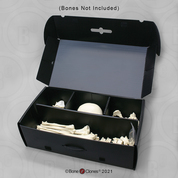
S-81 | Plastic Case For Human and Great Ape Skulls | Durable and economical storage and carry case for natural bone and replica human skulls. This case is suitable for Bone Clones Great Ape and Hominid skull replicas as well... |
S-91 | Premium Carrying Case for Human Skull | The Premium Carrying Case for Human Skull is a durable storage and carrying case for natural bone and replica human skulls. This case is both attractive and resilient... |
YS-001 | Saltwater Crocodile Skull 1:12 Scale | A sculpture based on our BC-229 skull on a 1:12 scale by a talented art student, Yurie Ishizaka... |